

Small Business Loans in Virginia
They say Virginia, The Old Dominion state, is for lovers, and Virginians love their small businesses. If you already have a business in Virginia or are looking to start one, the state has plenty of resources to help you find the financing to get going or expand your business.

Types of Virginia Small Business Loans
Major corporations are flocking to Virginia and bringing thousands of new jobs with them. Recently, Amazon, Boeing, Raytheon, and Nestle announced that they are opening new facilities in Virginia, largely due to the state’s abundance of talented personnel and the favorable business environment.
This influx of new businesses will create more opportunities for small businesses in Virginia. Entrepreneurs will create new startups, and existing businesses will expand. And all of them will need additional money to fund their operations. Fortunately, Virginia has plenty of opportunities for small business owners to find the funding they need.
SBA loans
SBA loans are business loans that are partially backed by the Small Business Administration (SBA), a federal agency. These loans are serviced by private lenders, but are popular because they generally have good interest rates.
Line of credit
Use a line of credit as a flexible form of financing. Unlike with a loan, this option does not involve a big disbursement upfront that you must repay, providing a flexibility that better fits many entrepreneurs’ needs.
Term loan
Term loans are common small business loans in which you would apply for a large disbursement of capital and then repays it over several years, along with fixed or variable interest.
Equipment finance
With equipment financing, you receive a piece of equipment and then pay off the cost of the equipment in installments. This way, your business can make money off the equipment immediately, even if you don’t have the funds to buy it at the sticker price.
Accounts receivable financing
Accounts receivable financing is an alternative form of business financing in which your unpaid invoices serve as collateral for a lump disbursement of funds.
Virginia Small Business Loan Options
The Old Dominion state has numerous commercial banks, government agencies and nonprofit organizations that offer loans and other financing options to small businesses.

Atlantic Union Bank is headquartered in Richmond and is a top lender for SBA loans, lines of credit, and term loans.

Virginia Credit Union offers equipment loans, lines of credit, and business credit cards. Credit unions are generally more lenient than commercial banks and offer loans at lower rates.
Virginia Community Capital (VCC) Is a nonprofit that offers management advice and financing to small businesses. In addition to lending for SBA Loans, VCC also offers loans to refinance debt and business acquisitions.

Virginia SSBCIi Cash Collateral Program is a state-funded program that provides cash collateral in those instances where the borrower does not have enough collateral to meet the lender’s requirements.
Virginia SWaM Business Microloan Fund provides smaller loans that are not attractive for a bank or other conventional lenders.

M&T Bank provides funding for new and established businesses in Virginia and is nationally recognized as a Top 10 SBA lender.
Four simple steps to funding.
Tell us about your business.
Answer a few simple questions and complete the application in minutes.
Submit your application.
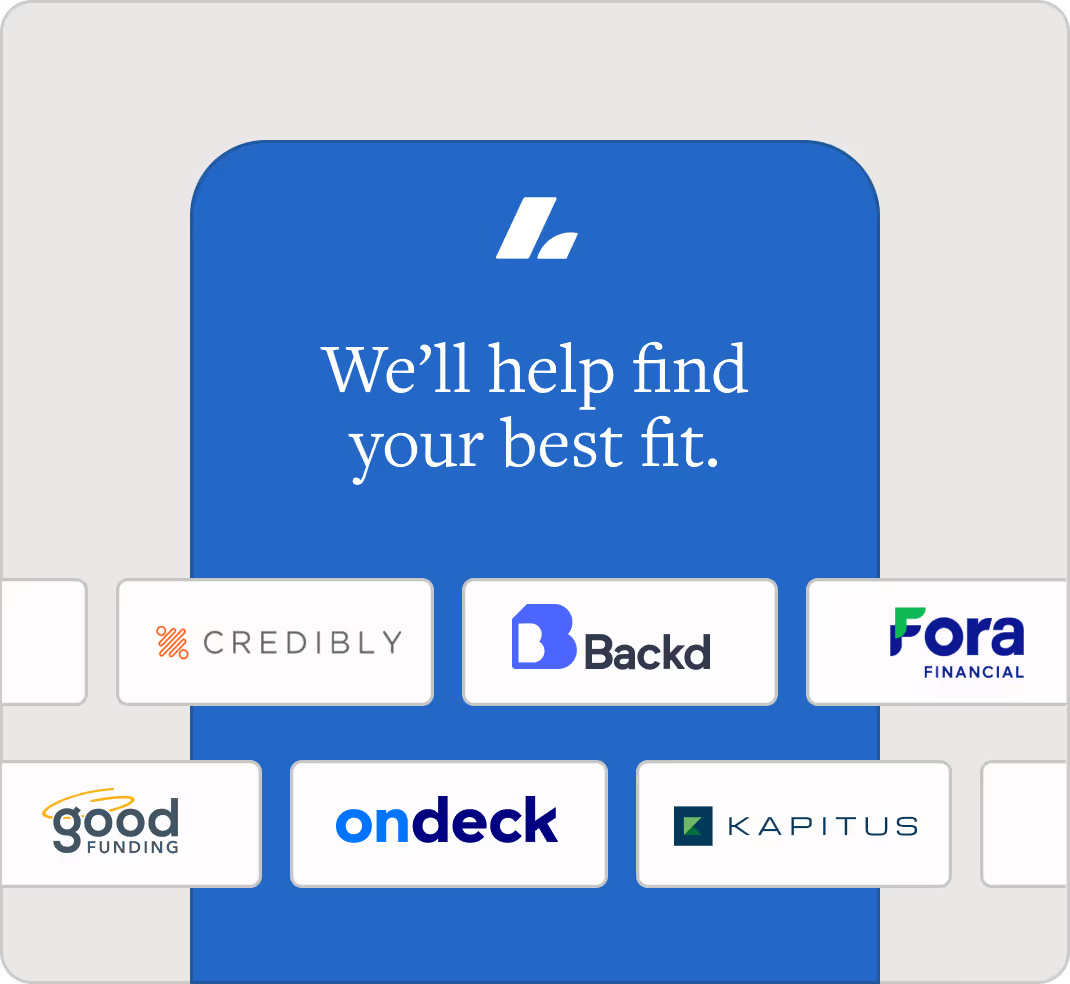
We’ll present your application to our marketplace 100+ lenders. Applying is free and won’t impact your credit score.
Compare offers.
Find the funding option with the terms that best fit your small business goals.
Get funded.
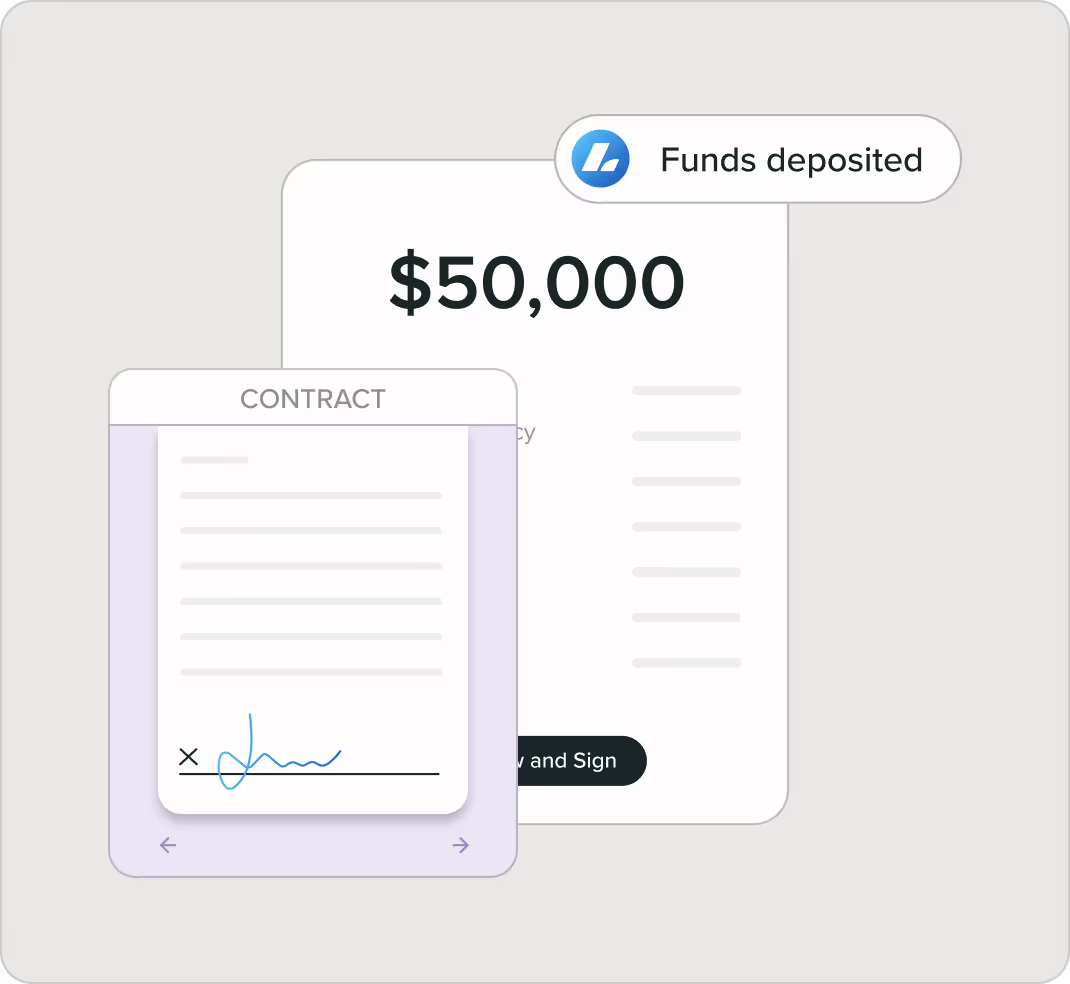
Once you accept, funding can hit your bank account in as little as 24 hours.


FAQ about Small Business Loans in Virginia
Read experiences from Virginia business owners.

Green Leaf and Pebble Tea Spa
I recently had the opportunity to talk with Dennis R. Stebbins of Green Leaf and Pebble Tea Spa about his experience starting his business, running it and finding a loan through Lendio to improve his business. Here’s his experience with Lendio along with advice for small business owners in his own words.
Tell me a little bit about your business.
Green Leaf and Pebble Tea Spa, in Virginia Beach, VA, is a full-service medi-spa integrated with a totally organic, loose leaf, fair trade based tea shoppe so as to provide the customers and guests a total health and wellness experience.

In the spa, we provide a full line of skincare treatments, a wide variety of bodywork (massage) modality services, an Infrared Sauna experience and opening just this next week; a Himalayan Salt Spa treatment room. Our services and treatments in the spa combine modern and ancient methodologies to give one as wonderful spa experience as possible.
With regard to our tea shoppe, we offer over 90 organic teas, all with numerous health and wellness benefits, as well as having a full line of tea accessories for our patrons. Our extensive selection of organic teas are specially chosen for their therapeutic benefits, as well as for their great aromas and flavors. Complimentary teas of choice are served our spa patrons after their sessions. Customers of the tea room have the option to purchase individual cups of hot or iced tea or any of our organic teas in bulk.
In the 3 years we’ve been open, we’ve won over a dozen local and regional awards and honors for our services, both on the skincare realm, as well as with our massage services. We were selected and certified in 2014 as the first EcoSpa in the United States and more recently, we were selected as a State of Virginia – Virginia Green tourist attraction for our unique spa and environmental / eco-friendly operations.
Why and when did you start it?
We incorporated our business in September of 2012 and opened the doors of our business on November 19th of 2012 after an extensive build-out of the facility we leased. My wife, Katherine, was/is a Master Aesthetician and had worked in the industry both as a practitioner and manager prior to our spa’s incorporation. Katherine, who also has a management degree, came to a point in her life where she felt she could run a successful spa business on her own – thus, the conception of the business.
How did you get the initial capital to start your business?
Initial capital of approximately $120,000.00 for Green Leaf and Pebble Tea Spa came directly from all of our life savings. We believed in what we were doing, so we jumped in with both feet – “believing” we could swim. No additional investors were initially involved. After a few months in operations, we brought on one minor investor to assist us for an immediate financial need for capital, in the amount of $5,000.
What keeps you going? What’s your passion that drives your business?
We have had very scary struggles in building the business, especially over the course of the first couple of years when we didn’t know if we would be able to stay in business more than a few more days. The scare or risk factor was ever-present, primarily in having the need to constantly build business by bringing in clients for our spa services and customers for our tea business – alas, revenue. As we steadily built our business, however, we found that steadfast focus and faith in what we were doing was the best course of action.
I don’t think there is ever a time, as an entrepreneur, that one is not nervous about one’s business success – but confidence in what one does builds as the days go by, especially when seeing the return on investment coming in along with customer repetition. What drives the passion for our business? The simply complex answer to that is the desire to provide customers excellence in service in every aspect of our operations, to serve the community with a decent and honest business environment for our customers to enjoy and, of course, the passion to be successful. Once the passionate focus of striving for success, no matter the challenges, departs one’s consciousness, it becomes easy to fail.
Failing is not in my mindset, my wife’s mindset, nor that of our staff. In 3 years, we have built our business from just the two of us to a staff of 12 and we are still looking to bring more staff on. Certainly, we don’t want to let our staff and their employment go by the wayside, nor do we want our customers to lose a place in their lives wherein they can get wonderful spa services, great customer service and be in a beautiful, peaceful and pampering environment that we have striven so hard, every day, for them to have.
What did you need funding for?
One year ago, we expanded our operations by acquiring the lease of the office unit next door to us. This expansion doubled our size, allowing us to add three more spa treatment rooms, an employee lounge, a storage room and an expanded customer lobby for our Tea Shoppe. At the time we expanded, we found two lending sources that were not Lendio associated. At the time, we had not heard of Lendio. The loans were expensive and another risk based upon our financial needs. We successfully struggled through them to complete 90% of our expansion build-out before those funds ran out. We still needed capital, so we sought out a new financial partner which ended up being Lendio.
How did you find Lendio?
Because the customer service of the two financial firms we previously utilized was horrible, we sought out a new lender. We found Lendio thanks to a web-based ad that made the firm and its services seem perfect for what we were looking for. It was worth checking out, which we did. It only took a few minutes of our time to realize that the Lendio financial consultant we spoke with cared, really cared about what our needs were. Customer “service” was the initial key to us using Lendio. Needless to say, Lendio followed through with everything promised.
How was your experience with Lendio?
Our experience with Lendio has been, from the onset, nothing less than wonderful.
How was your experience with your Lendio rep?
Our Lendio representative was/is Ms. Meghan Finning. We have nothing but wonderful things to say about Meghan and the over-the-top, superlative customer service she has been providing us. She is a wonderful representative of Lendio and certainly a person everyone in the business lending industry should consider emulating. She knows her stuff and she is wonderful, as well as professional, in what she does. To top the cake, she listens and cares about our business and our success. She is not just out to bring in clients for loan offerings, she is there for her clients every step of the way as a means to build the professional relationship and to help one’s business grow.
Would you recommend Lendio to a friend?
ABSOLUTELY!
What general business advice do you have for other small business owners?
Stay the course in following your passion and never give-up on your dreams of success. Perseverance, stamina and having the guts to work through the toughest of times will bring success as long as your motives are honest and ethical.
You can find out more about Green Leaf and Pebble Tea Spa here. To get started with Lendio, you can fill out the popup form or go to lendio.com.
FAQs
SCORE Is a nonprofit organization sponsored by the SBA and made up of volunteer, retired executives. It has several chapters located throughout the state of Virginia to provide advisory services and mentoring to small business owners. In addition, the SBA has several offices of its Small Business Development Centers located across the state that can provide advice, suggestions, and other resources for small businesses. Virginia provides its own version of business advice and resources with its Business OneStop program.
Both new and existing companies may qualify for grants that are specific for the state of Virginia. You can check this site at the Virginia SBDC to find out which grants are applicable for your situation.
First, you have to decide on a business structure. It could be a sole proprietorship, a corporation or a Limited Liability Corporation (LLC). If you’re going to operate as a sole proprietorship, you will generally just need to register the name of your business with your county. If you are going to incorporate, you’ll need to register with the Virginia Secretary of State. Depending on your type of business, you may also need to obtain certain permits or licenses.
After you’ve taken care of the paperwork, you’ll need to prepare your documentation for the lender. You’ll need a business plan stating the purpose of the loan, cash flow projections, and how you intend to pay it back. Of course, each lender will have their own requirements, so you’ll need to do your homework to prepare for their needs.
The type of loan you’ll need depends on its purpose. If you’re looking to buy a piece of equipment, equipment financing could be a good fit. If you need to finance a temporary increase in current assets, then a revolving line of credit could be an ideal solution for your business. Online platforms like Lendio help you explore your financial options in just a few minutes—and at no cost to you.
Business startups and expansions of existing businesses need funding to support their growth and development. Small business loans offered by nonprofits and lenders in the state of Virginia are there to help you grow your business. Loans fill an important role in the capital structure of any business and finding the right lender and type of loan is important.
Ready for funding?
See what you can qualify for on the Lendio Marketplace.