


We ranked states based on the veteran labor market and entrepreneurship.
America’s military members are an industrious group once they enter civilian life. Veterans tend to out-earn their nonveteran peers—and indeed, the median income for veterans reached a record-high of $50,476 in 2022, compared with $38,254 among nonveterans.
Click here to see the top states.
Part of that may be due to their entrepreneurial spirit. There’s no shortage of notable veteran business owners, such as Nike co-founder Phil Knight, FedEx founder Frederick Smith, and Bob Parsons, who founded GoDaddy. Warren Buffett, one of America’s wealthiest people, has even said that the military taught him how to take orders, learn from others, and have fun doing it.

And while the number of veteran-owned businesses has been falling over time, research indicates that veterans are more likely to be self-employed than nonveterans, and that veterans with small businesses have higher average net worths than non-entrepreneurial veterans.
Veterans have unique skill sets and discipline that may prime them perfectly to lead. In surveys, veterans tend to say that their military service helped prepare them to run a small business. But even so, they're more likely than nonveterans to be concerned about business regulations, lack of connections, financing, and getting customers—which could point to a lack of support for veteran entrepreneurs in parts of the country.

Lendio analyzed six metrics to determine the best states for veterans to succeed in business, including veterans’ income, employment, and business ownership, as well as startup survival, patent innovation, and new business growth. Those metrics were split into two subcategories: veteran labor market and entrepreneurship.
The results indicate that the best states for veteran entrepreneurs are scattered across the country, with no one region dominating the list. Support for veterans can be found everywhere—but some states offer softer landing pads for veterans as they decide where to set up shop or expand their businesses.
Some Key Findings:
- Virginia is the No. 1 best state. Driven by strong earnings and employment. Virginia veterans’ median income was $68,124 in 2022, compared with $41,429 among nonveterans.
- Top states span across the U.S. Wyoming, Oregon, West Virginia, and South Dakota rounded out the top five states. They typically had high rates of veteran business ownership (for example, 7.3% in West Virginia) and veteran employment (58.5% in South Dakota).
- States with the strongest veteran labor market aren't always the most entrepreneurial. Some states scored well for one subcategory, but not the other—such as No. 11 Alabama, which ranked second for veteran labor market, but 47th for entrepreneurship. That means states that came out on top in the overall ranking struck a good balance between being good for veteran workers and for those starting a business.
Top states
No. 1: Virginia
Virginia is a great state for veterans in the labor market, given that 58.7% of veterans there are employed and their average earnings are 1.6 times higher than nonveterans—better rates than anywhere else in the U.S.
No. 2: Wyoming
Wyoming scores well for both subcategories (8th for the veteran labor market and 6th for entrepreneurship), helping drive it up to the No. 2 spot overall. The state saw a 42.7% increase in new business applications year over year, the highest rate in the country, plus the median income for veterans is 1.4 times higher than that of nonveterans.
No. 3: Oregon
Oregon lands in the middle of the pack for the veteran labor market, but its strong environment for entrepreneurs helped propel it to the No. 3 ranking. The state reports 96.4 patents per 100,000 population, while 58.4% of startups survive at least five years, the highest rate in the U.S.
No. 4: West Virginia
In West Virginia, 7.3% of businesses are owned by veterans, whose median earnings are 1.4 times as high as those of nonveterans. Further, its startup survival rate is 55%, and it saw 25.9% yearly growth in new businesses.
No. 5: South Dakota
In 2022, 58.5% of South Dakota’s veterans were employed, while 6.1% of businesses are veteran-owned. Meanwhile, 55.7% of startups survive at least five years, the second-highest rate after Oregon.
No. 6: Massachusetts
Massachusetts has a high rate of patents (125.6 per 100,000) and a high startup survival rate (55%), driving it to the best state in the entrepreneurship subcategory. Its veteran workers perform fairly well, with 5.2% of businesses owned by veterans and 46.2% of veterans being employed.
No. 7: Alaska
Alaska’s veterans earn 1.5 times as much as nonveterans, based on median income in 2022. It also has one of the highest employment rates for veterans, at 57.5%.
No. 8: New Hampshire
New Hampshire has one of the highest rates of veteran-owned businesses, at 7.7%, and it saw 80 patents filed per 100,000 population in 2020.
No. 9: New Mexico
Veterans in New Mexico out-earn nonveterans by a ratio of 1.6—the third-highest ratio in the U.S. after Virginia and Alabama. The state also saw 32.8% year-over-year growth in new business applications, behind only Wyoming.
No. 10: Maryland
Maryland was propelled to the top 10 by its high level of veteran employment (54.3%) and strong income ratio, given veterans’ median income is 1.4 times higher than nonveterans’.

Runners-up
The runner-up states tend to excel for either their veteran labor markets or for their entrepreneurship more broadly. For example, 6.8% of businesses in Alabama are owned by veterans, whose median income is 1.6 times higher than nonveterans—a higher rate than almost anywhere else. Texas and South Carolina also scored especially well for their veteran labor markets, driven by their high income ratios (each 1.5).
Meanwhile, states like California, Washington, and Kentucky scored well due to the force of their entrepreneurial communities, with California reporting more patents per 100,000 population than any other state (127.8) and Kentucky seeing 30.5% year-over-year new business growth. Washington also has a high patent rate at 118 per 100,000.

5 tips for veterans to start a business
Veterans have valuable skills and experiences to translate to the private sector. But while it can be highly rewarding to run your own business, getting your firm started is a major endeavor that takes time, planning, and effort. These tips will help you get going:
- Develop a strong business plan - Begin with a well-researched business idea, emphasizing your unique value in the niche or industry you’ve selected. Consider your financial projections, marketing tools, and operations plan.
- Research grants and loan opportunities - The Small Business Administration offers programs, grants, and loans designed to support veteran entrepreneurs, such as the Boots to Business initiative. Some organizations and nonprofits also offer financial support and coaching.
- Network - Connect with other entrepreneurs, veterans, and mentors who can offer guidance and support. Get involved with the local business community and join industry-specific groups to spread the word about your business.
- Establish solid legal and financial structures - Choose wisely whether it makes the most sense to establish an LLC, sole proprietorship, or corporation. Make sure to also separate your personal and professional finances and ensure you’re compliant with federal and local regulations.
- Be patient - It takes time to establish a successful business. With the right tools in place, you'll be able to stay resilient as you get your business up and running.
Conclusion
The success of veterans as entrepreneurs underscores their impressive contributions to the American economy. Our findings emphasize the need for continued efforts to empower veteran entrepreneurs, allowing them to harness their full potential to lead and excel in the business world.
Methodology
We used the most recent federal data for six metrics across two categories to determine the best states for veterans to start a business. We used a Z-score distribution to scale each metric relative to the mean across all 50 states and Washington, D.C., and capped outliers at 3. A state’s overall ranking was calculated using its average Z-score across the six metrics, while its subcategory ranking was calculated using its average Z-score across the three relevant metrics. Three states were missing data for veteran business ownership (Virginia, Wyoming, and Oregon) so their scores were calculated across the remaining five metrics. Here’s a closer look at the metrics we used:
- Veteran labor market
- Share of employer businesses owned by veterans, 2020 (Census Bureau)
- Median income ratio, veterans to nonveterans, 2022 (Census Bureau)
- Employment rate among veterans, 2022 (Bureau of Labor Statistics)
- Entrepreneurship
- Five-year startup survival rate, March 2022 (Bureau of Labor Statistics)
- Patents per 100,000 population, 2020 (U.S. Patent and Trademark Office)
- Growth in new business applications, Aug. 2022-2023 (Census Bureau)

Small businesses looking for an infusion of cash could benefit from up to $400 billion in refundable tax credits through the Employee Retention Credit program based on a Lendio analysis of internal and SBA data. Signed into law as part of the CARES Act to provide relief during the COVID-19 pandemic, the Employee Retention Credit allows qualifying small businesses who retained W-2 employees throughout 2020-2021, to claim up to $26,000 per W-2 employee.
On average businesses that apply through Lendio receive $74,000 through the ERC. Qualified businesses with less than two W-2 employees average $13,000, and companies with 25+ W-2 employees average $302,000.
Based purely on the number of small businesses and the number of W-2 employees at those businesses the highest potential amount totals up to $1.5 trillion, but after going through complex qualification criteria, businesses get, on average, $7,000 per W-2 employee out of the maximum $26,000.
Full qualification requirements include:
2020 qualifications:
- Qualifying wages of up to 100 full-time W-2 employees;
- A decrease in gross revenue of at least 50% compared to the corresponding quarter in 2019;
- Or either a full or partial suspension of business operations created by a government mandate
2021 qualifications:
- Qualifying wages of up to 500 full-time W-2 employees
- At least 95% of businesses in every state have less than 500 employees
- A decrease in gross revenue of at least 20% compared to the corresponding quarter in 2019
- Or either a full or partial suspension of business operations created by a government mandate
ERC Opportunity By State
By combining SBA data on:
- Number of small businesses in each state in 2020 and 2021
- Number of small business W-2 employees in each state in 2020 and 2021
With Lendio data on the typical credit amount small businesses qualify for, Lendio found the potential dollar amount available to SMBs in each state.
| State | # Of Small Businesses | Likely ERC Potential Available For SMBs |
| AK | 73,981 | $955,463,790.00 |
| AL | 408,374 | $5,650,103,976.00 |
| AR | 258,552 | $3,435,787,167.00 |
| AZ | 611,097 | $7,693,400,000.00 |
| CA | 4,200,000 | $50,921,700,000.00 |
| CO | 674,741 | $8,258,300,000.00 |
| CT | 355,596 | $5,181,664,955.00 |
| DC | 79,814 | $1,776,757,105.00 |
| DE | 88,051 | $1,325,359,503.00 |
| FL | 2,800,000 | $25,043,900,000.00 |
| GA | 1,100,000 | $11,889,800,000.00 |
| HI | 137,328 | $1,925,000,584.00 |
| IA | 273,969 | $4,559,925,524.00 |
| ID | 176,029 | $2,333,867,134.00 |
| IL | 1,200,000 | $17,485,000,000.00 |
| IN | 529,456 | $8,392,800,000.00 |
| KS | 258,012 | $4,212,078,665.00 |
| KY | 360,756 | $5,007,094,984.00 |
| LA | 464,527 | $6,338,986,883.00 |
| MA | 715,425 | $10,491,000,000.00 |
| MD | 618,214 | $8,392,800,000.00 |
| ME | 150,593 | $2,052,182,977.00 |
| MI | 902,131 | $13,288,600,000.00 |
| MN | 533,344 | $9,092,200,000.00 |
| MO | 542,519 | $8,392,800,000.00 |
| MS | 264,858 | $3,061,171,849.00 |
| MT | 126,219 | $1,739,868,328.00 |
| NC | 964,280 | $11,889,800,000.00 |
| ND | 75,427 | $1,371,983,121.00 |
| NE | 180,988 | $2,904,851,376.00 |
| NH | 137,811 | $2,125,962,145.00 |
| NJ | 937,436 | $13,154,100,000.00 |
| NM | 158,844 | $2,398,205,747.00 |
| NV | 297,183 | $3,635,511,059.00 |
| NY | 2,300,000 | $28,675,400,000.00 |
| OH | 982,035 | $15,386,800,000.00 |
| OK | 362,364 | $4,997,755,842.00 |
| OR | 396,925 | $6,220,658,087.00 |
| PA | 1,100,000 | $17,485,000,000.00 |
| RI | 106,412 | $1,611,751,698.00 |
| SC | 445,804 | $5,788,076,766.00 |
| SD | 89,942 | $1,469,637,384.00 |
| TN | 636,842 | $7,693,400,000.00 |
| TX | 3,000,000 | $34,136,100,000.00 |
| UT | 313,590 | $4,220,845,106.00 |
| VA | 783,977 | $11,190,400,000.00 |
| VT | 79,189 | $1,105,428,062.00 |
| WA | 647,639 | $9,791,600,000.00 |
| WI | 461,525 | $9,092,200,000.00 |
| WV | 113,184 | $1,899,631,463.00 |
| WY | 70,618 | $911,135,280.00 |
States Most Likely To Qualify
While Lendio’s analysis found potential money available largely aligns with the population of each state, certain states and industries are more likely to have businesses who qualify for the Employee Retention Credit based on the number of government mandates that impacted businesses and how broadly pandemic precautions impacted certain industries.
Businesses in the following states are most likely to qualify for the Employee Retention Credit based on being above average in the following variables:
- Average number of qualifying quarters
- Percent of the qualifying quarters revenue was impacted
- Percent of the qualifying quarters a government order impacted that industry
- Percent of the time there was no government order
- Average last date of government order
| State | Z Score |
| NY | 3.85 |
| MI | 3.77 |
| NJ | 3.45 |
| WA | 3.00 |
| CO | 2.90 |
| CA | 2.69 |
| NM | 2.05 |
| OH | 2.00 |
| MD | 1.92 |
| MA | 1.88 |
| IL | 1.12 |
| AL | 1.06 |
| NV | 1.03 |
| OR | 0.80 |
| LA | 0.77 |
| PA | 0.71 |
| MO | 0.00 |
ERC Opportunity By Industry
The following industries are most likely to qualify for the Employee Retention Credit based on being above average in the following variables:
- Average number of qualifying quarters
- Percent of the qualifying quarters revenue was impacted
- Percent of the qualifying quarters a government order impacted that industry
- Percent of the time there was no government order
- Average last date of government order
| Industry | Z Score |
| Gym | 3.98 |
| Amusement / Recreation | 3.68 |
| Church | 3.63 |
| Beauty Salon | 3.43 |
| Restaurant | 3.06 |
| Real Estate | 2.79 |
| Retail | 2.69 |
| Laundry Services | 1.52 |
| Bakery | 1.48 |
| Assisted Living | 1.36 |
| Manufacturing | 1.16 |
| School | 1.15 |
Advice For Small Businesses
Recent news around ‘ERC Mills’ taking advantage of small businesses is a great reminder to all small business owners to work with reputable companies when filing their tax credit. Lendio has been supporting small businesses for over a decade and has facilitated more than 350,000 small business loans in addition to facilitating more than $10 billion in PPP loan and ERC approvals as part of government COVID-19/CARES Act relief.
The qualification criteria for the ERC have evolved over time. Credible ERC professionals can help you navigate these details and maximize your refund.
If you are qualifying due to a full or partial suspension rather than a decline in gross receipts, providing detailed documentation of how your business was impacted by a government order is key to ensuring your application is approved.
- Was your ability to provide goods or services to your customers affected? Did foot traffic in your store go down by 10, 20, 30%? Or did you lose half of your contracts because Zoom meetings didn’t cut it? There are lots of ways to be specific here.
- Were any external businesses impacted by government orders that then impacted your normal operations? If you had a hard time getting supplies from vendors, let us know the dates, vendor names, and details.
- Visit our ERC FAQs for more information about the Employee Retention Credit.
If in doubt about whether you’ll qualify for the money, still apply for free. You may be surprised by what you can qualify for.
Sources
Lendio Proprietary Data
ERC Pros Proprietary Data

With the rise of the so-called “unicorn startup,” it can be easy to get caught up in the myth that, to start a successful new business, one must be young, have millions of dollars of funding, and plan to grow the business to be the size of Facebook or Amazon. The number of startups funded by venture capital has risen over the years. However, most small businesses start without external investment, and the majority of startup founders are middle-aged.
Failure rates
Startup failure rate statistics.
Startup companies are often considered the backbone of economic growth and innovation, with the potential to disrupt traditional industries and create new markets. However, the reality is that starting a business is risky with no guarantee of success. In fact, statistics show that the majority of startups fail within the first few years of operation.
21% of new businesses fail within the first year.
Source: BLS
Starting a new business is a risky venture. This underscores the importance of careful planning, market research, and a solid business strategy to ensure a greater chance of success.
Nearly half of all startups fail by year five.
Source: BLS
While surviving the first year is crucial, it is not enough for long-term success. This highlights the need for sustained growth, innovation, and adaptability to keep a business thriving over the long term.
Oregon, South Dakota, Mississippi, California, and Massachusetts have the highest five-year survival rates of 55% or more. Missouri has the highest five-year failure rate at 60.5%.
Source: Lendio
Location can be a significant factor in a startup's success or failure. This may be due to a variety of factors, such as a less-supportive business environment, lower access to capital or talent, or other systemic barriers.
Startup challenges
Startup challenges statistics.
Starting a new business is an exciting and rewarding experience, but it is also a daunting task that comes with a host of challenges. So, what is standing in the way of startups’ success? From securing funding to developing a viable product or service, entrepreneurs face numerous obstacles that can make or break their business.
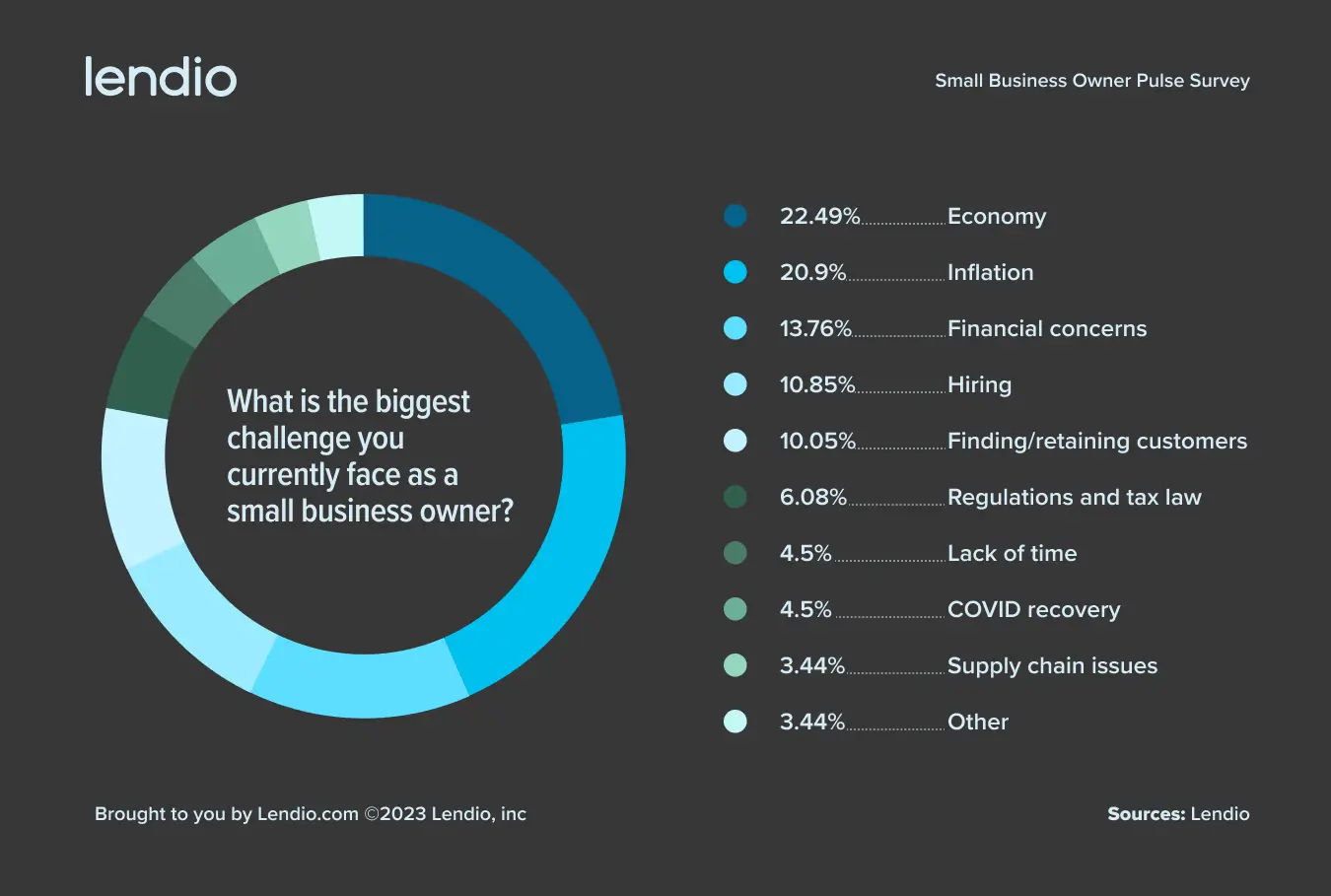
41% of small business owners state their No. 1 challenge is related to the economy and inflation, with another 14% dealing with other financial concerns.
Source: Lendio
This highlights the need for small businesses to carefully monitor economic conditions, manage cash flow effectively, and seek out resources and support to overcome financial challenges.
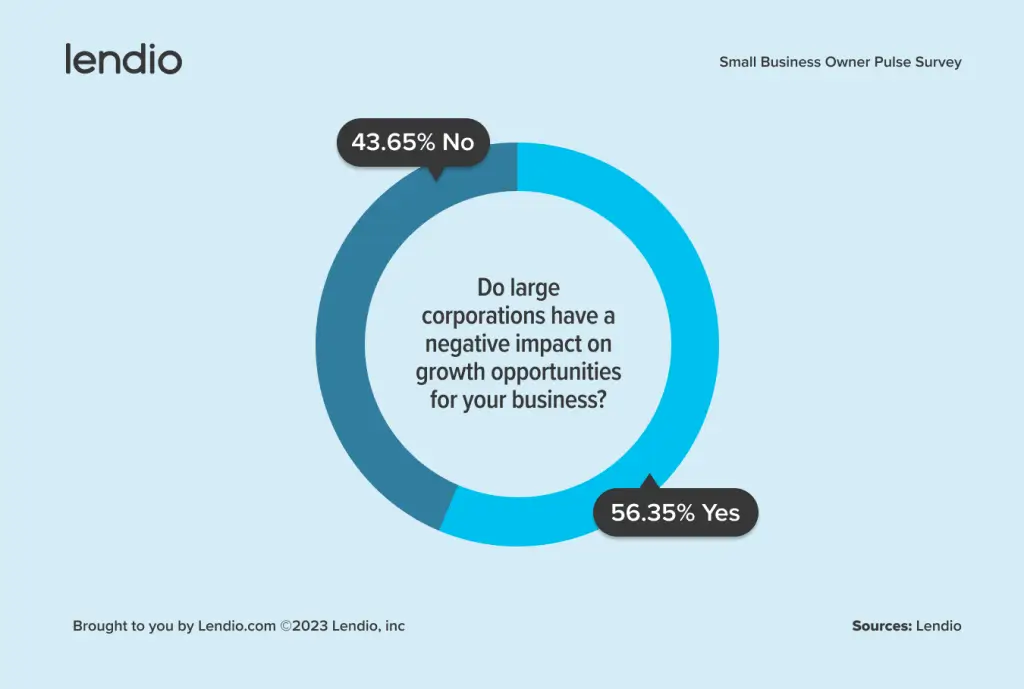
56% of small businesses state that large corporations have a negative impact on growth opportunities for their business.
Source: Lendio
This may be due to factors such as competition for customers or talent. It may also be the ability of large corporations to invest in technology and marketing that small businesses may not be able to match. As such, small businesses may need to focus on developing unique value propositions, building strong customer relationships, and seeking out niche markets where they can excel.
52% of businesses state access to capital would have had a significant impact in their ability to start a successful business.
Source: Lendio
This highlights the importance of a robust and accessible financing ecosystem, including traditional loans, venture capital, and alternative sources like crowdfunding.
Startup funding
Startup funding statistics.
Starting and growing a business requires capital, and finding sources of funding is often a top priority for entrepreneurs. From traditional bank loans to venture capital investments, there are numerous options available to businesses seeking funding, but obtaining funding can be a challenge for most early-stage startups. In fact, the majority of businesses are started with personal funds.

- 54% of SMB owners started their business with personal funds. (Source: Lendio)
- 43% of small business owners needed less than $10,000 to fund their startup. (Source: Lendio)
- Only 3% of startups are funded through venture capital firms. (Source: Lendio)
- Colorado, Utah, and Minnesota have the highest access to small business loans. (Source: Lendio)
- Massachusetts, California, and New York have the highest amount of venture capital disbursed per $1 million of GDP. (Source: Lendio)
- In 2021, early-stage funding totaled $201 billion. (Source: Crunchbase)
- Global venture funding was more than 10x higher in 2021 than in 2012. (Source: Crunchbase)
- Overall, Kickstarter has successfully funded more than 200,000 projects totaling $6.5 billion in successful funding. (Source: Kickstarter)
- 40% of Kickstarter projects are successfully funded. (Source: Kickstarter)
- 66% of Kickstarter startups raise $10,000 or less. (Source: Kickstarter)
- 77% of tech Kickstarters fail. (Source: Kickstarter)
Unicorn startups
Unicorn startup statistics.
The term "unicorn" is used to describe privately-held startups with a valuation of $1 billion or more. These companies are often seen as the darlings of the tech industry, with the potential to disrupt traditional markets and generate massive returns for investors. While unicorn startups represent only a small fraction of all startups, their impact on the economy and the technology landscape is significant.
- There are 1,206 unicorn startups worldwide valued at ~$3791 billion dollars. (Source: CB insights)
- Bytedance, an artificial intelligence company in China and parent company of TikTok, has the highest valuation at $140B. (Source: CB insights)
- SpaceX has the second-highest valuation at $127B. (Source: CB insights)
Startup demographics
Startup demographic statistics.
Entrepreneurship is often seen as a means of achieving the American dream, with the potential to create wealth and opportunity for individuals and communities. However, not all entrepreneurs have the same opportunities to start and grow their businesses. In fact, access to resources and support can vary significantly based on a variety of demographic factors, including age, race, gender, and education.
Age
Contrary to popular belief, the majority of startup founders are middle-aged, and studies have found that older founders may have a higher chance of success than younger founders.
- On average, entrepreneurs are 42 years old when they found their company. (Source: HBR)
- In software startups, the average age is slightly younger at 40. (Source: HBR)
- In oil and gas and biotechnology companies, the average age is around 47. (Source: HBR)
- Entrepreneurs' success rates increase with age, peaking in the mid-50s. (Source: HBR)
Gender
Recent statistics highlight both the progress made and the challenges that remain for women entrepreneurs. On the positive side, startups with female founders are shown to perform better. However, there are still significant disparities in funding and representation. Female business owners tend to ask for less funding than men, and they often face more difficulty securing loans or lines of credit.
- Startups with a female founder perform 63% better than startups that have all-male founding teams. (Source: First Round)
- The proportion of female co-founded companies has doubled from 10% in 2009 to 20% in 2019. (Source: Crunchbase)
- On average, female business owners ask for less funding, about $35,000 less than their male counterparts.
- Women business owners make multiple attempts to secure bank loans or lines of credit, and 40% of women business owners applying for a loan never succeed in obtaining funding.
- Women represented just 6.4% of the CEOs on the most recent Fortune 500 list—and that was the highest female-male ratio in the list’s 63-year history.
- Top 10 States for Women’s Access to Capital:
- South Dakota
- Maine
- Mississippi
- New Hampshire
- North Carolina
- Virginia
- Washington
- Delaware
- Indiana
- Oregon
Source: Lendio
Race
In 2018, Black-owned businesses represented 9.9% of all businesses, while Hispanic-owned businesses represented 12.2%. However, these businesses tended to be smaller and less profitable than non-minority-owned businesses. (Source: Census Bureau)
Only 1% of venture-funded startup founders were Black and just 1.8% were Hispanic. (Source: Stanford)
The National Bureau of Economic Research found that Black-owned businesses were more likely to be denied loans than white-owned businesses, even when controlling for creditworthiness and other factors. (Source: National Bureau of Economic Research)
These startup statistics demonstrate the challenges and opportunities that come with starting and growing a business. While the failure rate of startups can be discouraging, it is important to remember that entrepreneurship plays a vital role in driving innovation and economic growth.
Additionally, it is crucial to acknowledge the systemic barriers that exist in the entrepreneurial ecosystem and work towards creating a more inclusive and equitable environment for all aspiring entrepreneurs. As we continue to track and analyze startup statistics, let us strive to create a world where anyone with an idea and the drive to succeed has the opportunity to do so.
Lendio is committed to helping small business owners survive and thrive by making funding more accessible to small business owners. Learn more about small business loan options.

The American Dream, once the ethos of the United States, offering the highest aspirations and equal opportunities for a comfortable life, has changed. What is the American Dream in 2023, and is the American dream still attainable?
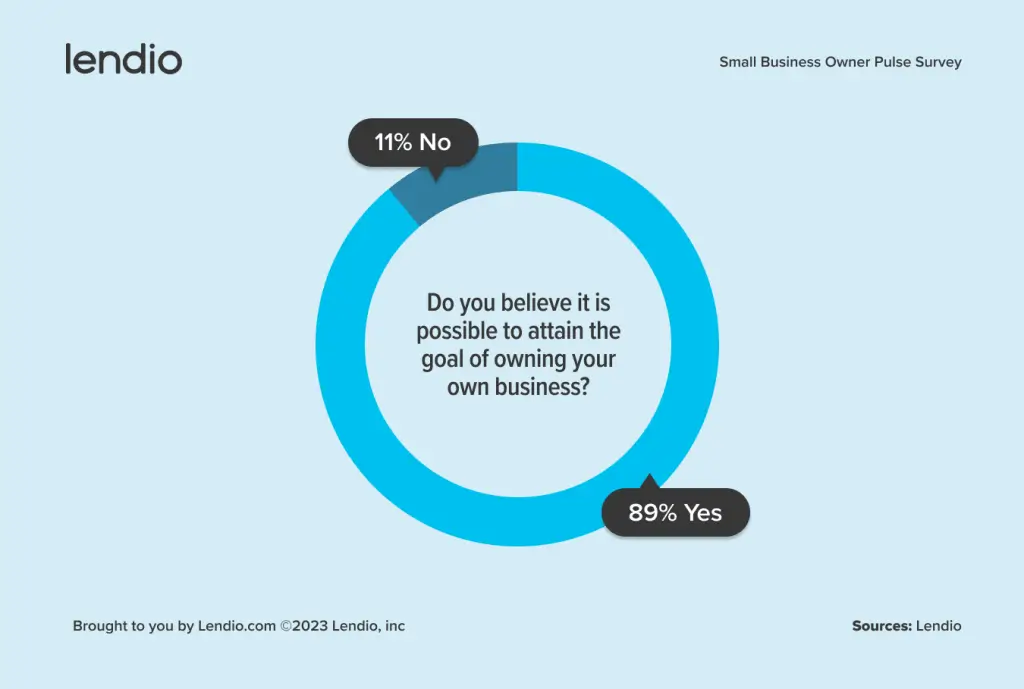
A recent Lendio survey of more than 350 small- and medium-sized business owners across the U.S. found that, while 49% of small business owners believe it is somewhat or much harder to own a small business than it was in the past, 89% still believe it’s possible to reach that goal.
American dream definition.
How small business owners define the American dream.
The original definition of the “American Dream” was based on the prospect of equality, justice, and democracy. Evolving into the belief that anyone can become what they strive to be—the opportunity for upward mobility, economic success, and attaining the life one has always dreamed would be fulfilling.
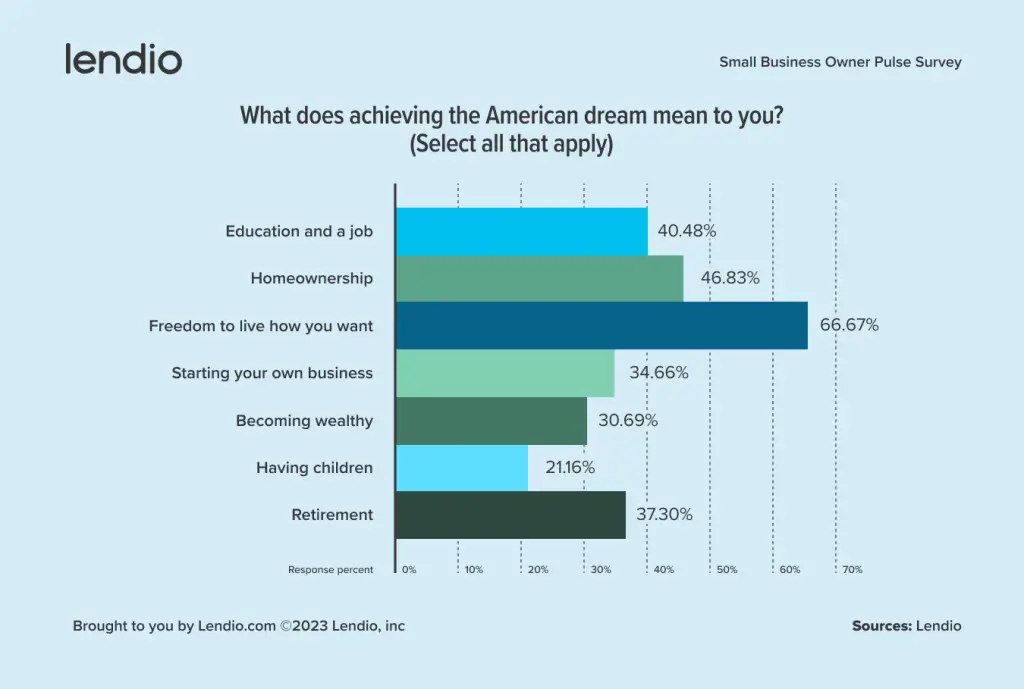
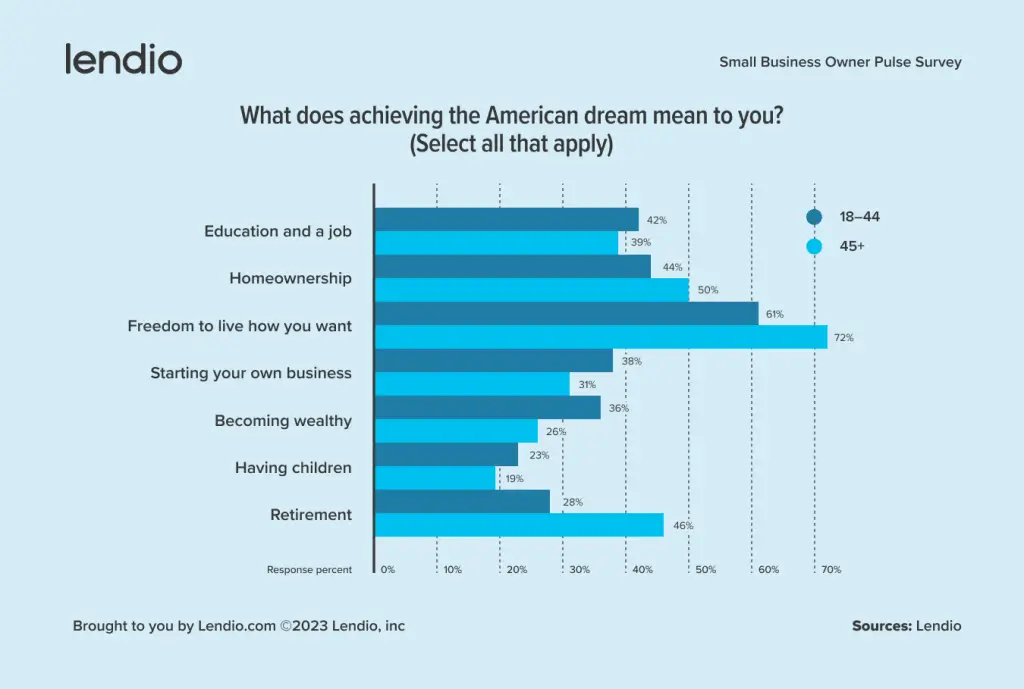
As times have changed, so has the idea behind the dream. While traditional components, such as homeownership (46%) and starting a business (34%), are still identified as important by small business owners, 67% identify freedom to live how you want as the primary component of the American Dream.
| What does achieving the American dream mean to you? (Select all that apply) | Response percent |
| Education and a job | 40.48% |
| Homeownership | 46.83% |
| Freedom to live how you want | 66.67% |
| Starting your own business | 34.66% |
| Becoming wealthy | 30.69% |
| Having children | 21.16% |
| Retirement | 37.30% |
American dream challenges.
Small business owners remain optimistic but see growing challenges.
Starting a business is a significant step in obtaining the American Dream, and entrepreneurs can face many challenges. There’s no one solution for all businesses. But making a plan and accessing tools make it easier in today’s environment, where small business owners are one click away from equipping themselves in advance. Some of the biggest obstacles to tackle for small business owners include the following:
- Funding a business
- Finding and keeping customers
- Finding and keeping good employees
According to the survey, small business owners primarily face challenges related to the economy (23%), inflation (21%) and other financial concerns (14%). Hiring remains a primary challenge for 11% of small business owners. 56% of small business owners state that large corporations, such as Amazon and Google, have a negative impact on growth opportunities for their business.
Generational Differences
Generational differences
Millennials are a highly entrepreneurial group of business owners, with ages ranging from 27 to 42. In this high-rate environment with rising costs, layoffs, and the Great Resignation, we’ve seen a surge in startups. And according to Bloomberg, “creating successful companies is a young person’s game.”
But being an entrepreneur is not just for the young at heart, it’s the American Dream for people of all ages, with 31% of respondents aged 45+ stating that starting a business is part of achieving the American dream. Perhaps unsurprisingly, those owners 45 and above place greater importance on retirement (46%), while those under 45 place more importance on becoming wealthy (36%) as part of the American dream.
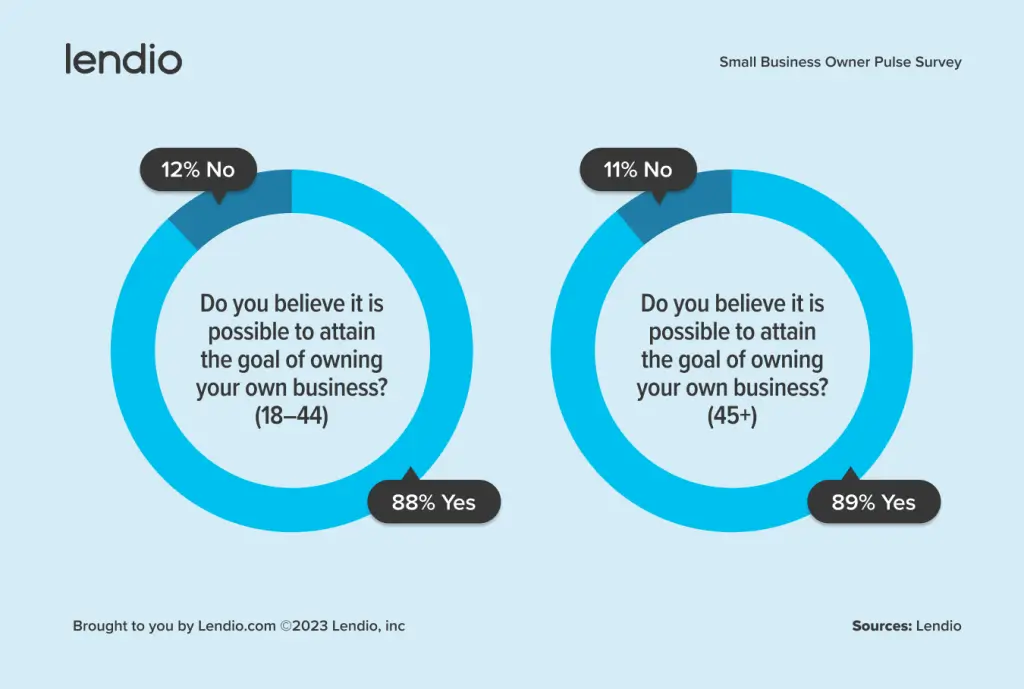
At a certain age, the American Dream can seem easy to give up on or unattainable. The analysis finds a clear correlation between age and sentiment among small business owners. Those over 45 are more pessimistic, seeing the American Dream as more challenging to attain in the current environment. In contrast, those under 45 find it slightly easier to achieve. But entrepreneurship is a reality for both the young and old, with 89% of those age 45+ still believing owning a small business is attainable.
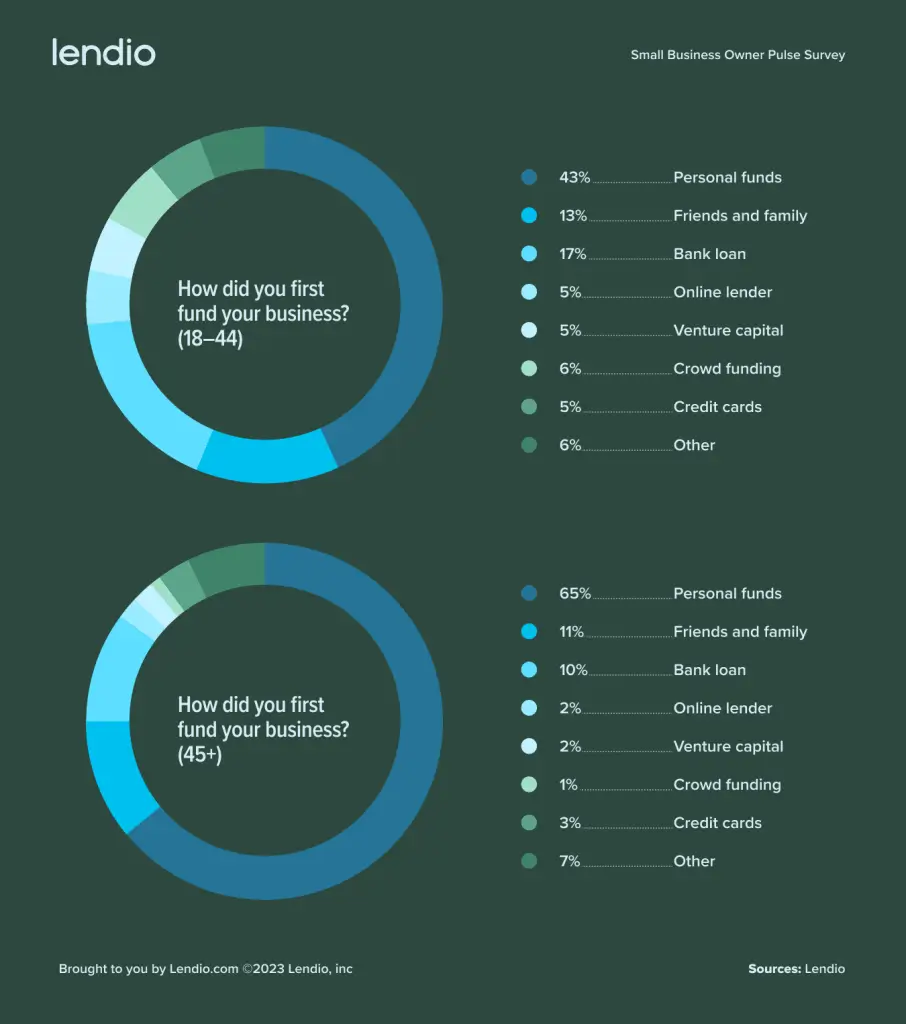
The two generations also fund their businesses differently. While both generations rely heavily on personal funds to start their businesses, those under the age of 45 have started to turn to alternative sources as well, such as crowdfunding (6%) and online lenders (5%).
Access to funding.
Access to funding is key for small businesses.
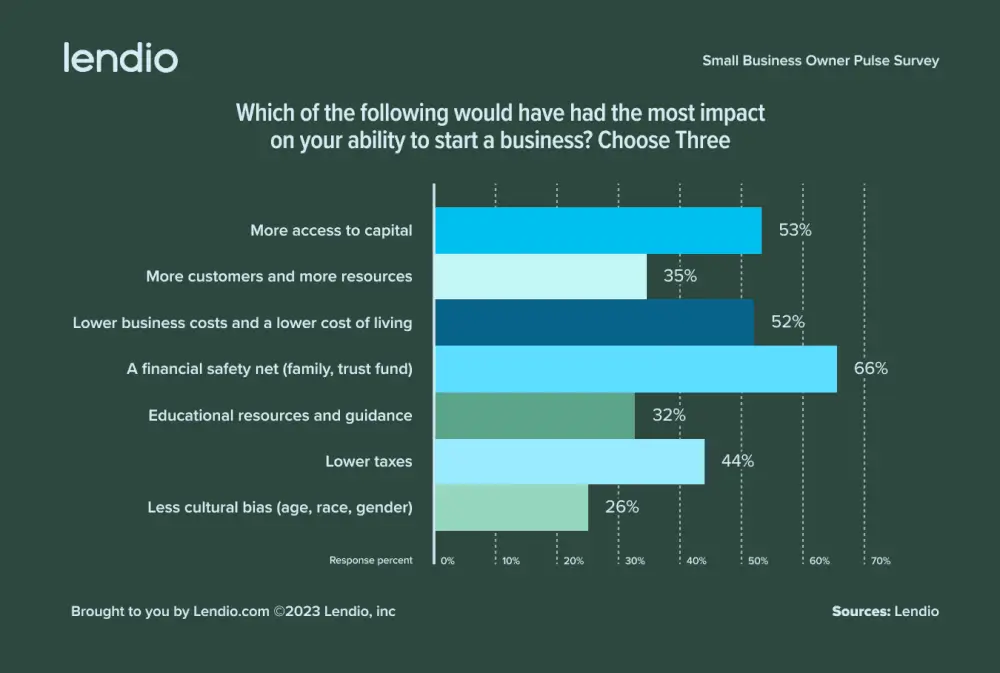
Access to capital and lower expenses are the key factors for creating an environment where entrepreneurs can start a business.
- 66% of small business owners state having a financial safety net would have had the most impact on their ability to start a business, followed by access to capital at 53%.
- Of the respondents, 52% state that living in an area with lower business costs and a lower cost of living would be helpful. 44% state lower taxes would have an impact.
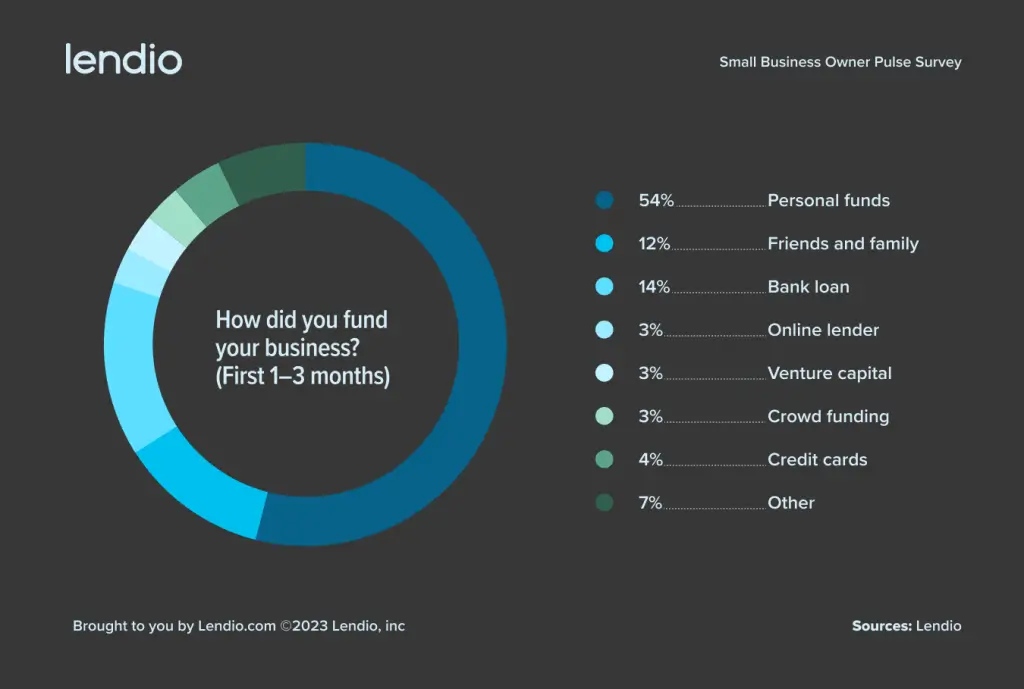
- 54% of SMB owners started their business with personal funds with another 12% relying on friends and family.
- 79% of SMB owners needed less than $100,000 to start their business with 43% needing less than $10,000.
Although 49% of respondents believe it’s somewhat or much harder today than in the past to achieve the dream of owning a small business, online loan marketplaces are making it much easier. Lendio is committed to helping entrepreneurs find the right small business loans for their small businesses, so they feel supported and optimistic in achieving their piece of the American Dream.
*Disclaimer: The information, methodologies, data and opinions contained or reflected in Lendio’s Small Business Owner Pulse Survey (the “Survey”) are proprietary of Lendio and is intended for informational purposes only. The Survey does not constitute business or legal advice, and is not a substitute for professional advice. The recommendations provided by Lendio are general industry recommendations, and are not a substitute for your business judgment. The Survey is based on responses to a survey provided by Lendio, but the opinions of those businesses may change over time. Thus, the Survey is not warranted as to its merchantability, completeness, accuracy or fitness for a particular purpose. The Survey is provided “as is” and reflects Lendio’s opinion at the date of their elaboration and publication. Lendio does not accept any liability for damage arising from the use of the Survey in any manner whatsoever. While every effort has been made to ensure that this Survey and the sources of information used herein are free of error, Lendio is not liable for the accuracy, currency and reliability of any information provided in the Survey.

We surveyed 350+ small business owners across the U.S. Here’s what they had to say.
KEY STATS
- 49% of small business owners believe it’s somewhat or much harder to achieve the dream of owning a small business than in the past.
- Those under the age of 45 skew slightly more optimistic with 46% stating owning a small business is slightly or much easier to achieve.
- Those over 45 skews more pessimistic; 58% believe it is slightly or much more difficult to reach that dream.
- Small business owners are primarily facing challenges related to the economy (23%), inflation (21%) and other financial concerns (14%).
- 66% of small business owners state having a financial safety net would have had the most impact on their ability to start a business, followed by access to capital at 53%.
- 54% of SMB owners started their business with personal funds with another 12% relying on friends and family.
- 79% of SMB owners needed less than $100,000 to start their business with 43% needing less than $10,000.
- A small business has been in business about three years (a median of 40 months) when it is first funded by an outside lender and receives a median amount of $47,000.
- 56% of small businesses state that large corporations have a negative impact on growth opportunities for their business.
Executive Summary
Lendio surveyed more than 350 small-and medium-sized business owners across the U.S. to gather insights about their ability to start and run a small business. The survey included measures of business owners’ most significant challenges, access to capital, impacts on growth, and their ultimate goals for starting a small business.
The analysis finds a clear correlation between small business owners’ age and sentiment. Those over 45 are more pessimistic, seeing starting a business as more challenging to attain in the current environment. In contrast, those under 45 find it slightly easier to achieve.
Inflation, economic distress, and labor force were the biggest challenges small business owners cite.
When asked how respondents funded their small businesses, 54% indicated personal funds, followed by bank loans. This survey, along with demographic indicators, can help identify and illuminate the experiences of current and future business owners spanning the different regions of the U.S. Overwhelmingly, responses have consistently shown that access to funding can make or break a company.
“With every business success story comes the ability to have an impact on your community—a ripple effect. 2022 was a challenging year. As we think about the coming year, we’re in your corner, we’re excited to cheer you on, and to help you overcome some of the business challenges you’re facing. We’re optimistic for 2023. We look forward to working with you to get you access to the capital you need to grow your business best.”
– Brock BlakeAlthough 49% of respondents believe it’s somewhat or much harder to achieve the dream of owning a small business today than in the past, online loan marketplaces are making it much easier. Lendio is committed to helping entrepreneurs find the best funding options for their small businesses, so they feel supported and optimistic about starting their small businesses.
Key Recommendations*
Based on survey results, we recommend the following to support small business owners:
- Loan Access - The rise of online lenders and lending marketplaces has increased access to small business loans, but there is still work to be done to improve small business’s access to funding through automationand faster approvals.
- Target Underserved Areas - Lenders should target underserved areas where respondents believe starting a business is less attainable. Those areas tend to also feel greater negative impacts caused by inflation, increasing costs, and economic strains.
- Educational Resources - Empowering small business owners through education and resources within their communities can be a major benefit to getting businesses off the ground.
Small Businesses Owners Face Challenges But Remain Optimistic
KEY STATS
- 49% of small business owners believe it’s somewhat or much harder to achieve the dream of owning a small business than in the past. 33% of SMB owners believe it is somewhat or much easier. 19% say it's about the same.
- 89% of small business owners believe it’s possible to attain the goal of owning your own business.
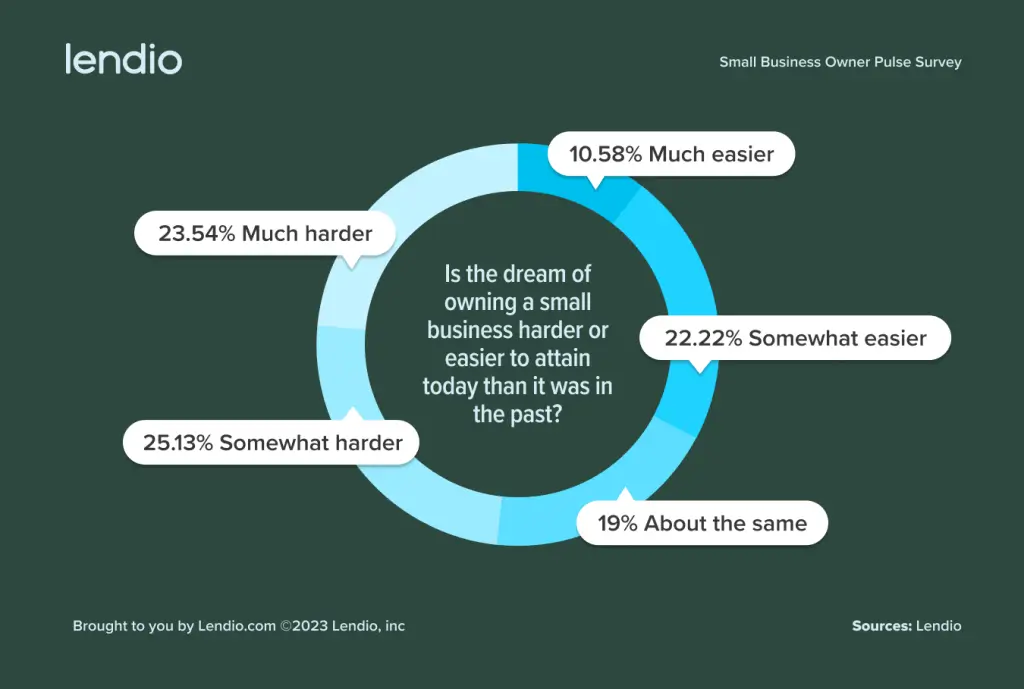
While 49% of small business owners believe it is somewhat or much harder to own a small business than it was in the past, 89% still believe it’s possible to reach that goal.
Entrepreneurs can face many challenges when starting a small business. There’s no one solution for all businesses. But making a plan, and accessing tools make it easier in today’s environment where small business owners are one-click-away from equipping themselves in advance. Some of the biggest obstacles to tackle for small business owners include the following:
- Funding a business
- Finding and keeping customers
- Finding and keeping good employees
The Economy’s Effects On Small Businesses
KEY STATS
- Small business owners are primarily facing challenges related to the economy (23%), inflation (21%) and other financial concerns (14%).
- Hiring remains a primary challenge for 11% of small business owners.
- 56% of small business state that large corporations have a negative impact on growth opportunities for their business.
The economy is experiencing a slowdown, and the Federal Reserve continues to increase interest rates to tame inflation. Business owners are feeling the effects. In a recent World Economic Forum poll, nearly two-thirds of the economists believe there will be a 2023 recession.
The post-pandemic environment has created many challenges, and small business owners still feel the ripple effects of COVID-19 protocols coupled with inflation. With inflation still at a 40-year high, we asked small business owners about their current biggest challenges.
Small business owners are primarily facing challenges related to the economy, inflation and other financial concerns. Challenges related to Covid recovery and supply chain issues are less of an issue.
Creating An Environment Where Small Businesses Can Thrive
Location, taxes, and socioeconomic factors help to evaluate the best environment for a business which is why we asked respondents to select three choices that most affected their ability to start a business.
Access to capital and lower expenses are the key factors for creating an environment where entrepreneurs can start a business.
KEY STATS
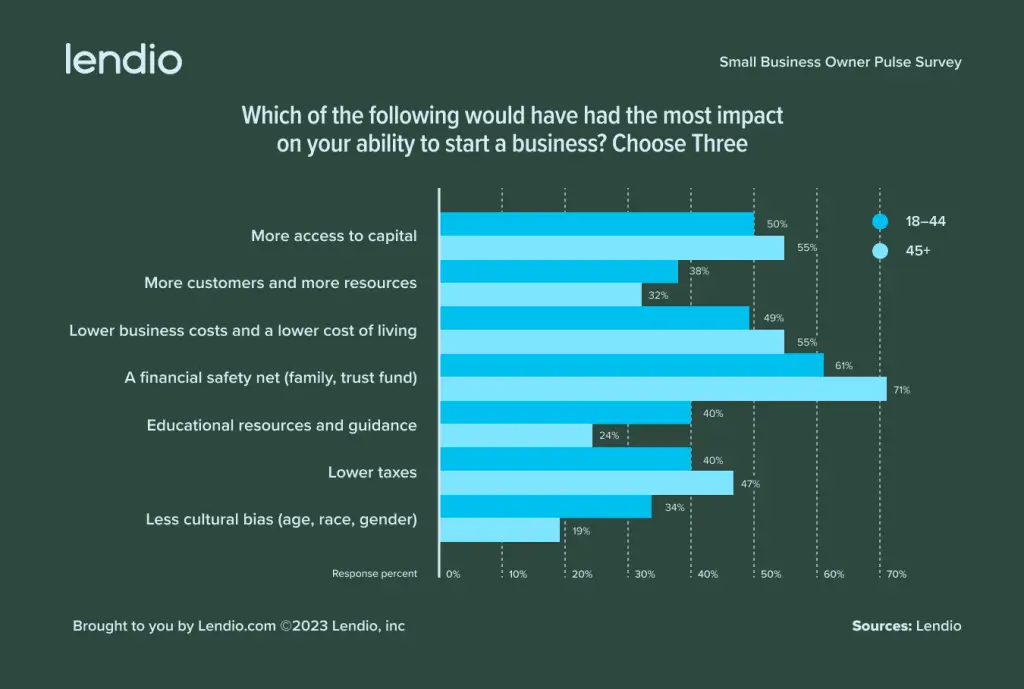
- 66% of small business owners state having a financial safety net would have had the most impact on their ability to start a business, followed by access to capital at 53%.
- Of the respondents, 52% state that living in an area with lower business costs and a lower cost of living would be helpful. 44% state lower taxes would have an impact.
Funding Stats
Start-up funding for a small business can come from one or multiple resources. One of the most common ways entrepreneurs fund their businesses is through savings or friends and family. Alternatively, an infusion of cash from a small business loan may be the way to go. With no shortage of financing options, we asked survey participants how they first funded their businesses.
KEY STATS
- 54% of SMB owners started their business with personal funds with another 12% relying on friends and family.
- 79% of SMB owners needed less than $100,000 to start their business with 43% needing less than $10,000.
- The average loan amount for a small business owner is $47,000.*
- A small business has a median of five employees when it is first funded by an outside lender.*
- A small business has been in business for about three years (a median of 40 months) when it is first funded by an outside lender.*
*Based on internal Lendio data of 300,000+ loans funded since 2013.
How Small Business Owners Define The American Dream
The original definition of the “American Dream” was based on the prospect of equality, justice, and democracy. As times have changed, so has the idea behind the dream.
The definition for most small business owners is relatively fluid. While traditional components, such as homeownership (46%) and starting a business (34%), are still identified as important, 67% identify freedom to live how you want to be the primary component of the American Dream.
Generational Differences
KEY STATS
- Those under the age of 45 report needing more money to start their business with 23% needing $100K-$250K while only 10% of those aged 45+ needed that amount.
- While both generations rely heavily on personal funds to start their businesses, those under the age of 45 have started to turn to alternative sources as well such as crowdfunding (6%) and online lenders (5%).
Millennials are a highly entrepreneurial group of business owners, with ages ranging from 27 to 42. In an environment with rising costs, layoffs, and the Great Resignation, we’ve seen a surge in startups. And according to Bloomberg, “creating successful companies is a young person’s game.”
But being an entrepreneur is not just for the young at heart; it’s a dream for people of all ages, and where economic downturns have historically driven growth, the generations looking to start anew fund their businesses differently.
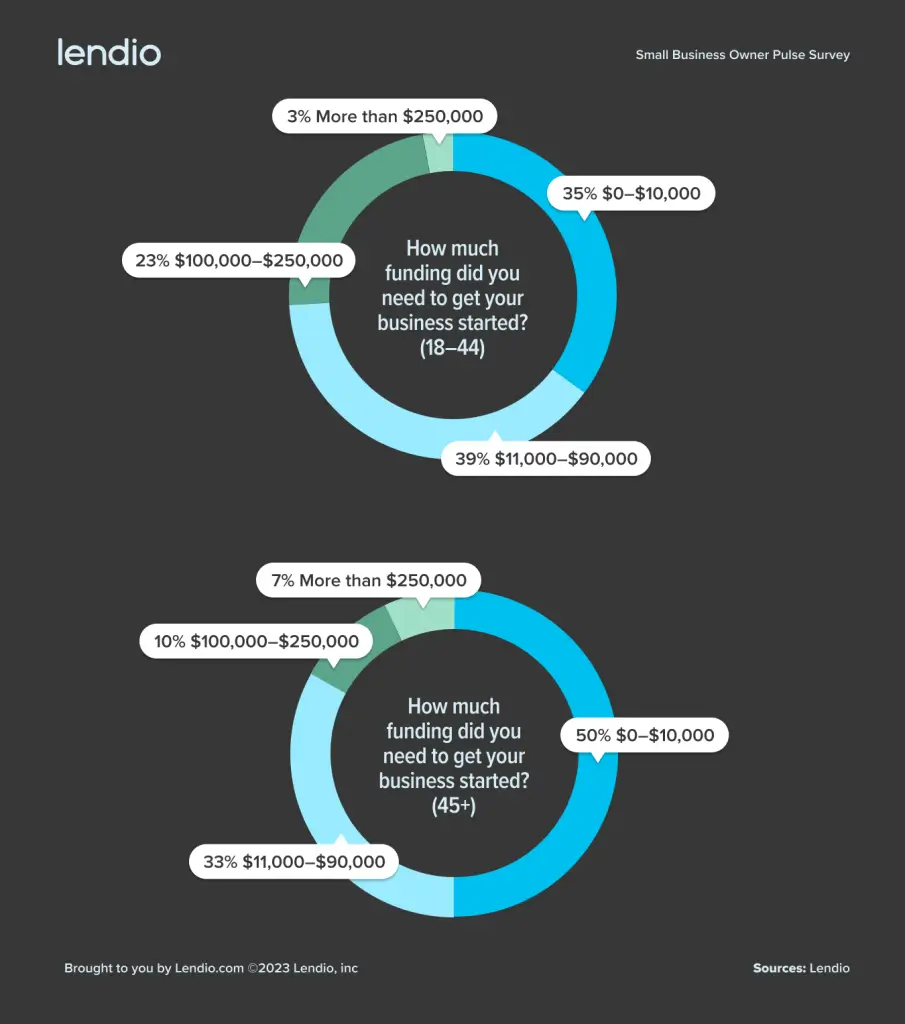
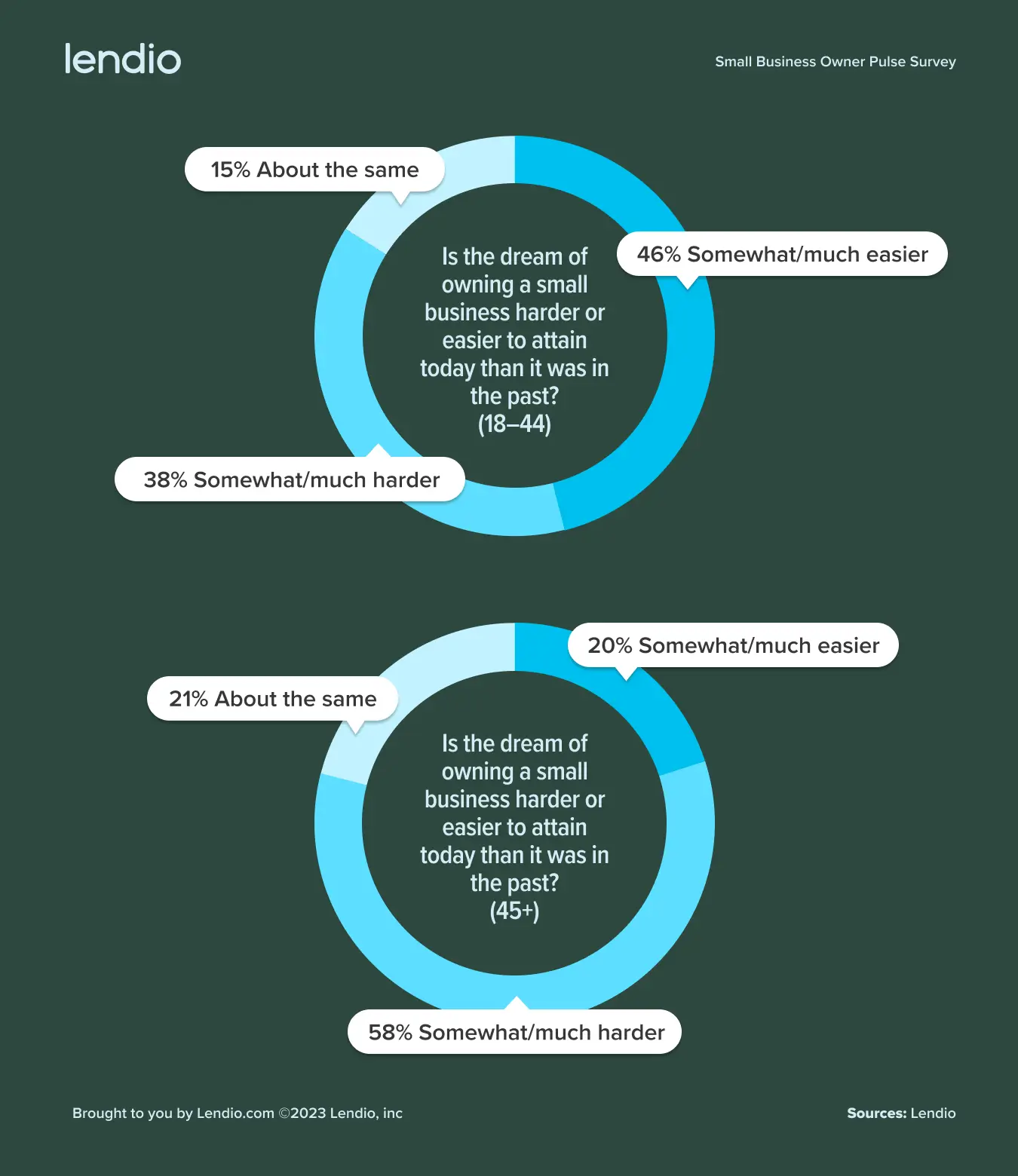
At a certain age, owning a business can seem easy to give up on or unattainable. But entrepreneurship is a reality for both the young and old. The survey showed a distinct difference in sentiment between younger and older business owners, with older business owners feeling more pessimistic and younger business owners feeling more optimistic.
KEY STATS
- 46% of younger business owners (18-44) believe owning a small business is somewhat or much easier to achieve.
- 58% of older business owners (45+) believe owning a small business is somewhat or much harder to achieve.
- Despite differing perceptions of challenges both generations agree it’s possible to attain the goal of owning your own business.
The survey also found generational differences in what helps or hinders a small business’s success and what those business owners value most in their life.
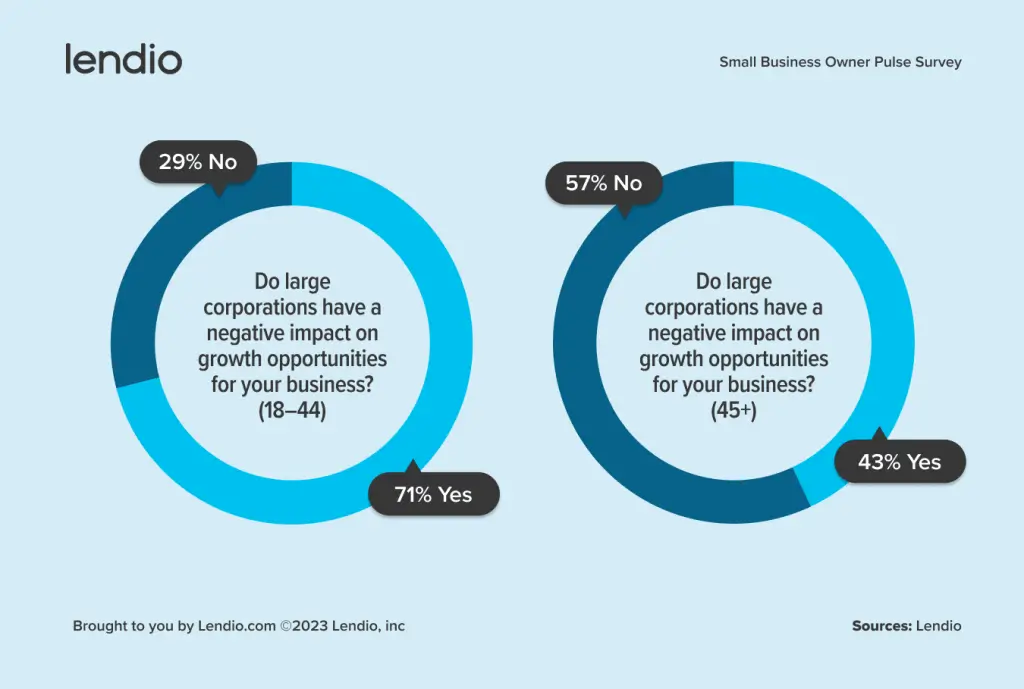
- While a large majority (71%) of SMB owners aged 18-44 believe large corporations have a negative impact on growth opportunities for their business, 57% of those 45 and above disagree, stating large corporations don’t have a negative impact on their business.
- While the generations agree that a financial safety net, access to capital and low costs are most critical to success, those 44 and younger place greater importance on access to educational resources and see cultural bias as a larger inhibitor.
- Both generations agree that the freedom to live how you want is the most important component of the American dream. Perhaps unsurprisingly, those 45+ place greater importance on retirement (46%) while those under 45 place more importance on becoming wealthy (36%).
Gender Differences
The survey found relatively few differences between genders other than the amount of funding needed to first start the business.
- A significantly greater number of women (49%) needed less than $10,000 to start their business than men (36%).
- A significantly greater number of men (21%) needed $100K-$250K to start their business than women (12%).

Geographic Differences
There were few significant differences across regions.
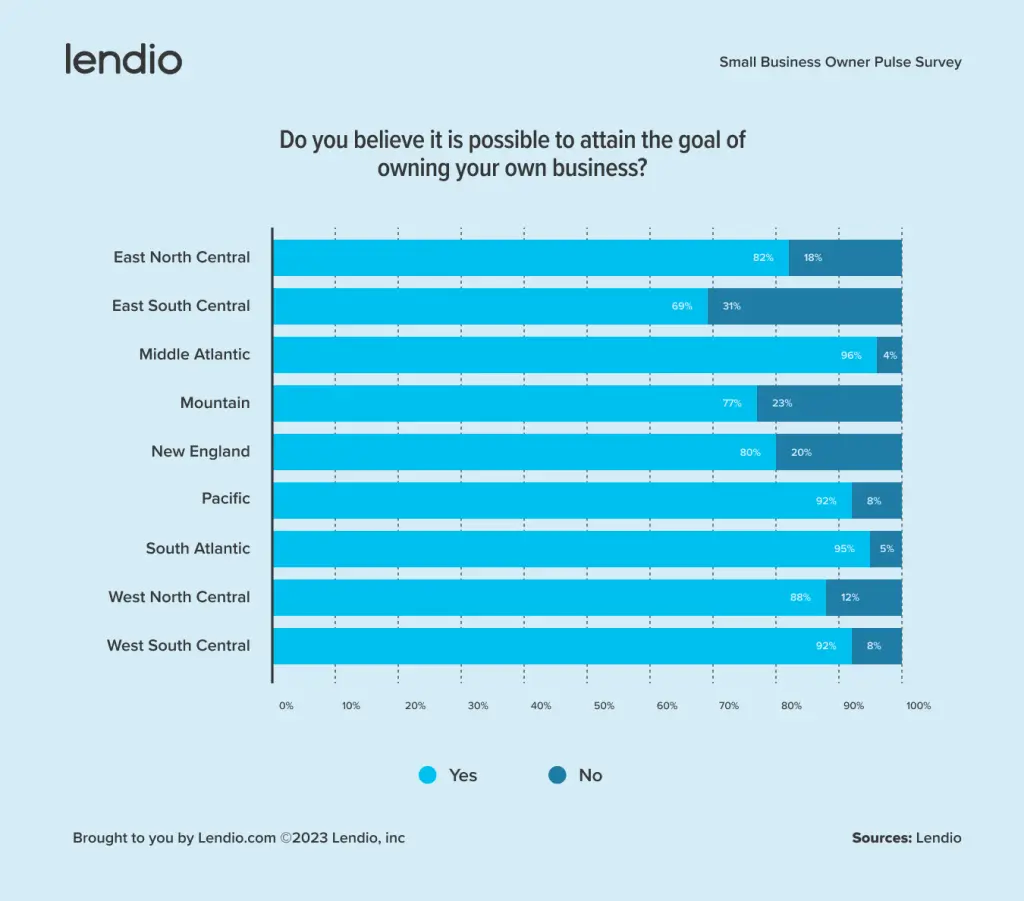
- The Middle Atlantic region (New York, New Jersey, Pennsylvania) had the most positive sentiment toward being able to start a business with 96% of respondents believing it’s possible.
- The East South Central region (Kentucky, Tennessee, Alabama, Mississippi) had the most negative sentiment, with 30% of respondents stating they didn’t believe it was possible to attain the goal of owning your own business.
*Disclaimer: The information, methodologies, data and opinions contained or reflected in Lendio’s Small Business Owner Pulse Survey (the “Survey”) are proprietary of Lendio and is intended for informational purposes only. The Survey does not constitute business or legal advice, and is not a substitute for professional advice. The recommendations provided by Lendio are general industry recommendations, and are not a substitute for your business judgment. The Survey is based on responses to a survey provided by Lendio, but the opinions of those businesses may change over time. Thus, the Survey is not warranted as to its merchantability, completeness, accuracy or fitness for a particular purpose. The Survey is provided “as is” and reflects Lendio’s opinion at the date of their elaboration and publication. Lendio does not accept any liability for damage arising from the use of the Survey in any manner whatsoever. While every effort has been made to ensure that this Survey and the sources of information used herein are free of error, Lendio is not liable for the accuracy, currency and reliability of any information provided in the Survey.