

Small Business Loans in Maryland
Maryland earned the title of “Old Line State” for the heroic fighting of its troops during the Revolutionary War. Today, Maryland’s regiment of small businesses—supported with loans from a sizable legion of banks, credit unions, and nonprofit institutions—deserves the same recognition of strength in the state’s economy.

Types of Maryland Small Business Loans
Lenders in Maryland know how to structure loans for small businesses engaged in healthcare, professional services, construction, real estate, retail, and high-tech manufacturing. Long-term loans can be arranged for purchases of fixed assets, short-term loans, or revolving lines of credit to meet working capital needs.
SBA loans
SBA loans are business loans that are partially backed by the Small Business Administration (SBA), a federal agency. These loans are serviced by private lenders, but are popular because they generally have good interest rates.
Line of credit
Use a line of credit as a flexible form of financing. Unlike with a loan, this option does not involve a big disbursement upfront that you must repay, providing a flexibility that better fits many entrepreneurs’ needs.
Term loan
Term loans are common small business loans in which you would apply for a large disbursement of capital and then repays it over several years, along with fixed or variable interest.
Equipment finance
With equipment financing, you receive a piece of equipment and then pay off the cost of the equipment in installments. This way, your business can make money off the equipment immediately, even if you don’t have the funds to buy it at the sticker price.
Accounts receivable financing
Accounts receivable financing is an alternative form of business financing in which your unpaid invoices serve as collateral for a lump disbursement of funds.
Maryland Small Business Loan Options
Bankers, credit unions, and numerous nonprofit financial institutions in the Old Line State support small businesses with a wide variety of loan programs. Lenders like to support the growth and development of small businesses because it increases the economic basis of the community and adds jobs.
Maryland Economic Adjustment Fund (MEAF) provides loans for underserved businesses with fewer than 50 employees to upgrade their operations, increase working capital, purchase real estate, or expand their markets.
Maryland Resource-Based Industry Financing Fund (MRBIFF) works with local vendors to provide low-interest loans for farmers to purchase land or capital equipment.

Neighborhood Business Works offers flexible financing to new and existing businesses located in older commercial districts or town centers.

In Baltimore City, Baltimore Business Lending offers microloans for small business owners with credit issues or insufficient collateral. BBL gives special consideration to women- and minority-owned businesses.

Maryland Small Business Development Financing Authority (MSBDFA) provides financing for businesses owned by economically and socially disadvantaged entrepreneurs.

Maryland Capital Enterprises provides funding for small and micro businesses in Maryland that wish to start or expand their businesses.

SECU is a top credit union in Maryland that offers multiple loan products to small businesses in the state.

The Harbor Bank of Maryland is provides several loan products including lines of credit, SBA loans, and commercial real estate loans to small businesses in the state.
Four simple steps to funding.
Tell us about your business.
Answer a few simple questions and complete the application in minutes.
Submit your application.
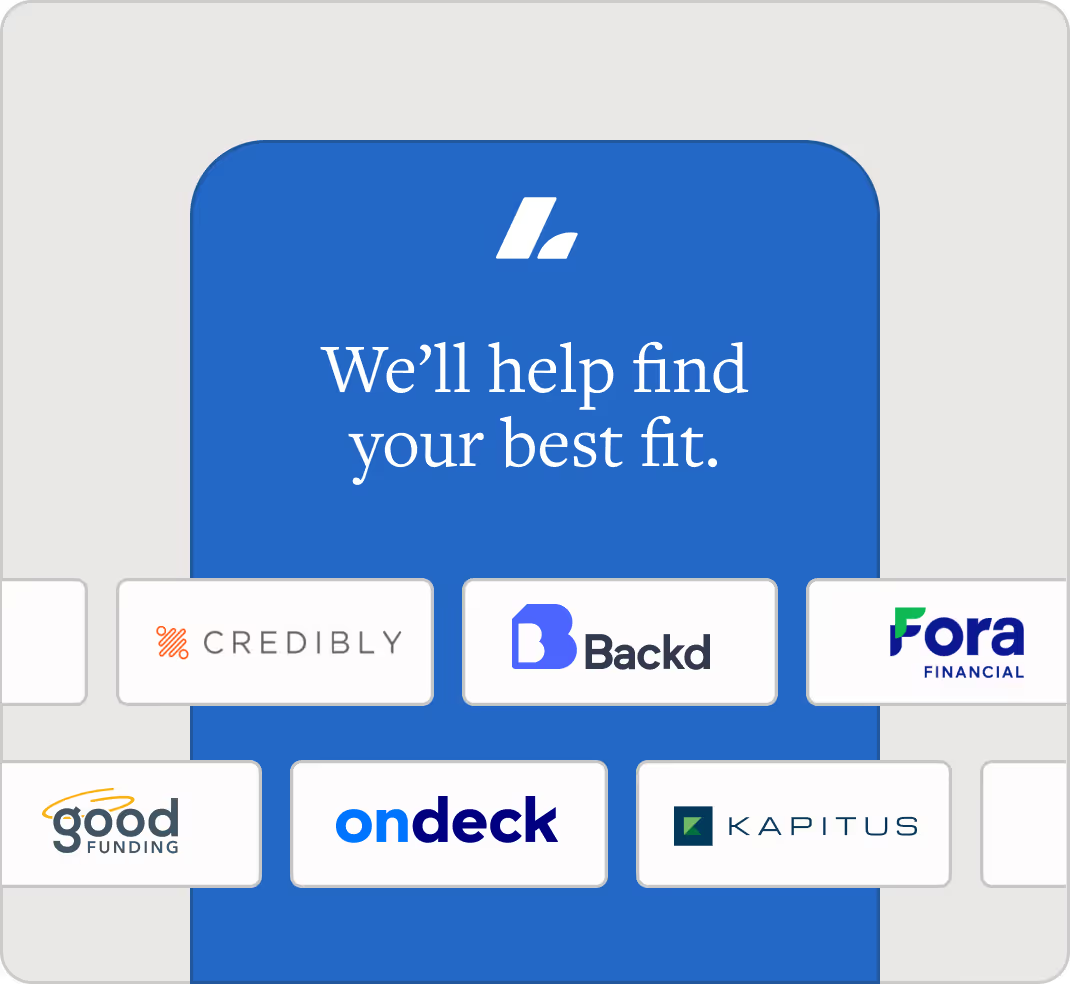
We’ll present your application to our marketplace 100+ lenders. Applying is free and won’t impact your credit score.
Compare offers.
Find the funding option with the terms that best fit your small business goals.
Get funded.
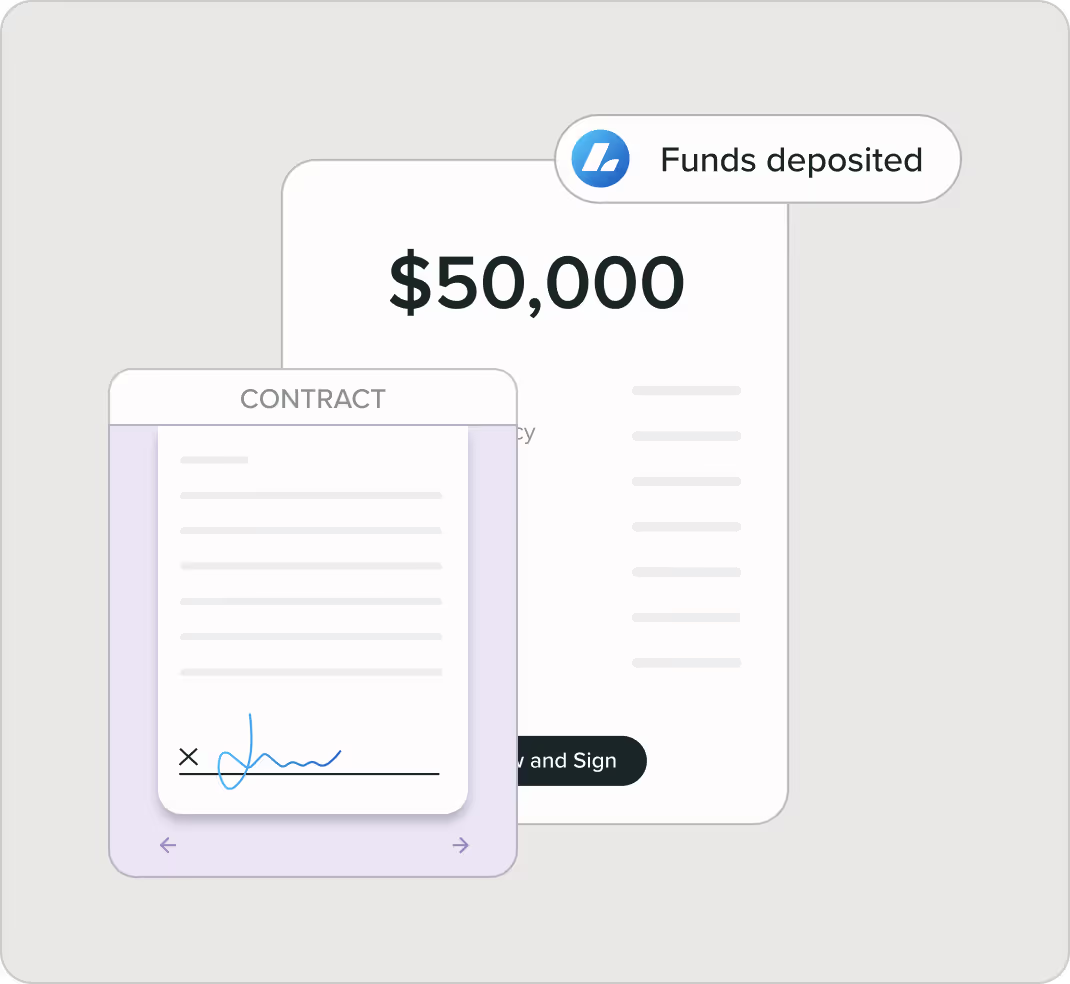
Once you accept, funding can hit your bank account in as little as 24 hours.


Recommended Next Reads
Read experiences from Maryland business owners.

Jidan Cleaning
Today, Jidan Cleaning is a full-service commercial cleaning company that specializes, according to their robust and detailed website, in “promoting healthy, safe, non-toxic work environments”—and what could be more important these days than a healthy and safe workplace?
We sat down recently with Pat to chat about her decision to strike out on her own, the inspiration behind her business, and the relationship she’s built with Lendio that’s helped her to expand Jidan Cleaning into a bustling tri-state business.
Where did the name Jidan Cleaning come from, and where are you based? Tell us a little about your “origin story.”
My daughters’ names are Jillian and Danielle, which is where the business name comes from.
Jidan Cleaning is a New Jersey-based company with a home office here in Medford, New Jersey, an office in Center City, Philadelphia, and one in Baltimore, Maryland.
My story starts with the fact that I'm an immigrant. I was born in Port of Spain, Trinidad, and came to the United States, to Jamaica, Queens, when I was six. The idea of immigrant success in the US, for many people, is owning your own business, so that was always in the back of my brain somewhere. Even when I was 12, I had my first paper route, and I employed my brother—I paid him to take care of part of my paper route and collect the money. The desire to own my own business started there.
I worked first as a pharmaceutical rep, and my physicians would always complain about their cleaning companies being unprofessional and their offices still being dirty. So I said, I'm going to bring professionalism to the cleaning business. That's where the light bulb went off. I started Jidan Cleaning in December of 2005, but I didn't leave my full-time job until May of 2010.
When I first started in South Jersey, we would get a lot of mom-and-pop physician offices or businesses that wanted to get cleaned once every other week, that type of thing. I realized [around 2013] that, if I wanted to increase my revenue, then I needed to be in a city: there are bigger buildings, so I’ll get bigger contracts and put more people to work. That's when I decided that I needed a Philadelphia office. Today, we have 105 employees (not contractors).
How did the pandemic affect Jidan Cleaners?
Overall, COVID has been a blessing for the cleaning industry. We’re now considered essential, so we're finally getting the respect that we deserve. There are two top ways that any business can show employees that it's safe to come back into their building: one is that folks are vaccinated, and two is that the building is clean. And how will you prove that the building's clean? By the folks that you employ to clean the buildings.
Why did you choose to seek out financing through Lendio?
Financing was one of the biggest challenges in starting my business, because most lenders put you in a box…My first business line of credit [from Lendio in 2014] was based on factoring my invoices. My biggest expenditure is always payroll, and the line of credit made that time of the month doubly less stressful. I've also gotten maybe two or three small term loans through Lendio.
Would you start Jidan Cleaners all over again? Is there anything you would change?
Yes, I would do it all over again—and as for what I would change, I would have done it sooner. I'm trying to live my best life, you know, and to help as many people as I can.

Vines to Vino
We recently had the opportunity of working with Monica Beeman to help her secure a small business loan for her new company. The company, called Vines to Vino, is Baltimore’s only winemaking establishment where you make the wine. Using grapes from the world’s finest vineyards, you crush, press, barrel, and bottle the wine under the guidance of a master winemaker.
Monica dropped us a line and talked about the positive experience she had with Lendio:
“I found Lendio while searching for a way to connect with angel investors and peer-to-peer funding websites. I quickly called and spoke with Darren Lunt (he made such an impression on me that I will never forget his name!) to ask questions about which level of service I should consider, as I was still unsure of how to structure investments in my business.
“I knew I had major obstacles to overcome because I had a bankruptcy 5 years earlier. Darren very bluntly instructed me to consider debt financing, which is what I wanted to pursue anyway. He suggested that I purchase the risk profile report. Having lost my job back in February and living on unemployment (with a newborn baby), I had NO money to purchase this. After begging a family member to borrow the money, I started my process with Lendio and purchased the Risk Profile Report.
“I was a little disappointed to read information that I already knew (I stay very current on my credit reports), but I was somehow energized to make the necessary changes to go from an 11% chance of funding to a 90% chance. Once again I was at a speed bump, as I now needed actual cash to make the changes to my personal credit and start building business credit. I spoke with Jordan in the Finance Dept and we made arrangements for me to start pursuing a microloan to accomplish this. We did this, understanding that with these changes, I would have a better chance of getting the funding I really need.
“I have since secured a $5,000 loan through and have been able to incorporate the business, build a website and print marketing materials, and I am now working with the legal group to dispute the negative information on my credit. Shortly, I will return to Lendio and re-apply for financing for a larger amount to bring Vines To Vino to operation!”
We wish Monica the best of luck in her new venture!
Check out the website here: http://www.vinestovino.com/
FAQs
In addition to the traditional lending resources, there are other organizations in Maryland that provide programs to assist new businesses with their financing and managerial needs.
The Maryland Small Business Development Centeroffers free consulting and training for small business owners and also assists a network for owners in connecting with lenders. At Mid-Maryland SCORE, business owners can get guidance and advice from experienced executives and corporate managers.
In addition to loans, small business owners in Maryland can also take advantage of various grants. The governor’s office of Maryland maintains a list of grants available from the state and private foundations. For federal grants available to Maryland businesses, you can search the website Grants.gov.
When you first set up your business, you’ll have to decide what type of business structure you intend to use. You can begin as a sole proprietorship, or you could start out by incorporating or setting up a limited liability company (LLC). If you’re incorporating or forming an LLC, you’ll need to register the name with the Maryland Department of Commerce.
Before you complete and submit an application, find out what documentation your lender needs. To increase your chances of getting your loan approved, you will want to present documentation that clearly states the purpose of the loan, how you intend to pay them back, and the collateral that will be used to secure the loan.
If you need the funds to purchase a fixed asset, such as equipment or real estate, you want to go for a long-term loan with the payments distributed over several years. If you need the funds to finance current assets or working capital, a line of credit or some other type of short-term loan,—such as advances against your accounts receivable—would be the best way to go. Repayments for both long-term loans and short-term loans should coincide with your cash flow. Online platforms, such as Lendio, have financial advisors who can help you assess the best financing instrument for your business, based on your needs.
Borrowing money to support the growth and development of your business is necessary to reach an acceptable return on your investment. Initial capital is often not enough to fund the operations of a business and provide a financing basis to support growth. Lenders exist with the mission to make loans to small businesses to expand their economic base and increase employment. Your business will be able to grow faster when you have working relationships with banks and credit unions helping you along the way.
Ready for funding?
See what you can qualify for on the Lendio Marketplace.