


If you’ve been wondering why the Federal Reserve raising interest rates recently has caused a stir in headlines, you’re not alone. Central bank policy can feel very distant from the day-to-day reality of running a business, but the Federal Reserve’s decisions can directly shape how much your next loan will cost, how lenders evaluate your application, and whether now is the right time to borrow.
This guide will break down the current rate environment for small business owners, what happened and why, and how to use that knowledge to your advantage when seeking financing for your business.
Let’s start with the basics: what do Fed decisions have to do with your monthly payment?
Understanding the federal funds rate.
First, while many headlines might use the shorthand “Fed approves interest rate hike” or “Fed lowers interest rate,” the reality is a little more nuanced. The Federal Reserve doesn’t set the interest rate on your specific loan, or directly set the federal funds rate that banks charge each other for overnight loans.
Instead, it sets a target range for the federal funds rate, within a .25-point band. This target range is what the Federal Reserve’s policy committee, the Federal Open Market Committee (FOMC) , aims to keep the federal funds rate inside. The FOMC meets eight times a year, and decides to raise, lower, or hold the target range. Then, they use administered rates, like the rate they will pay interest to banks on their reserves, to keep the actual overnight rate (the effective federal funds rate) inside the range.
Think of the target range like a thermostat. The FOMC sets the desired temperature, and uses the administered rates to work towards that temperature, like a furnace or AC system does. The effective federal funds rate is the actual room temperature.
Why does the Fed raise or lower the target?
The committee has a dual mandate, or two goals: keeping people employed, and keeping prices stable, which the Fed defines as inflation of about 2% a year. When prices climb too fast, it raises the target range to cool things down. When the economy needs a boost, it lowers the target.
September 2026 rate hike and how it affects small businesses.
At its September 15-16 meeting, the FOMC turned the thermostat up. The target range was raised by .25 percentage points, to 3.75%-4.00%, marking the first increase in the target range since 2023.
Why raise the target range? Fed Chair Kevin Warsh explained the reasoning at a press conference following the meeting. The economy looks healthy: unemployment is around 4.1% and hiring has picked up. But inflation has stayed above the Fed’s goal for more than five years, and he put total PCE inflation at about 3.6% in August. In his words, “inflation is too high and has been for too long.” With the job market solid, the committee chose to focus on prices.
A higher target range makes borrowing more expensive, which tends to slow spending and take pressure off prices.
The target increase creates a new baseline of 3.75-4.00% for rates, and that affects two interest rate benchmarks that appear frequently for small business borrowers:
- The Prime Rate rose to 7.00% (set at 3 points above the top of the federal funds rate target range). This rate is the common starting point for variable-rate small business and commercial loans.
- SOFR (Secured Overnight Financing Rate) rose to about 3.87% as of October 1 (3.75% as a 30-day average). It’s the benchmark most commonly used for larger or more complex credit facilities.
When the Fed moves the rate target range up or down, both of these benchmarks follow, and your borrowing costs can move with them.
What a quarter point increase means for your loan payments.
Interest rates are a real cost of doing business, especially on variable-rate loans. To illustrate, let's take a $500,000 variable-rate loan, priced on Prime +3%. This rate was 9.75% before the September hike, 10.00% after.
Note: this example is illustrative and assumes a fully amortizing loan and that the rate stays constant over the life of the loan.
A quarter-point change sounds small, but on a large business loan, it adds roughly $70 to $90 a month.
When the target rate increases, it could translate into thousands of dollars of additional cost over the life of the loan. The inverse is true, too. With a variable rate, when the target rate decreases, the cost of borrowing decreases. The dollars spent or saved could fund equipment, payroll, or inventory, which is why fluctuations have a real dollar impact on small businesses.
How lenders respond when rates change.
Fed policy doesn’t just change the price of borrowing, it can also impact how much risk lenders are willing to take on. When rates are lower, lenders typically expand their criteria and approve more applications, including from businesses with less-than-perfect profiles. In higher-rate environments, lenders tighten standards and focus on their most creditworthy applicants. Higher rates mean higher payments, so lenders look harder at whether a business has the cash flow to comfortably cover them.
Since 2008, banks surveyed by the Fed have generally eased lending standards when rates were very low, and tightened when they were high, though lenders tightened sharply in both the 2008 financial crisis and the 2020 pandemic even as rates fell. Rates are just one of the many things that lenders weigh. Economic certainty, competition, industry sectors, risk appetite, and rates all play a part for lenders in determining whether they tighten or loosen lending standards.
Fixed vs. variable: Choosing the right structure for right now.
The choice between a fixed and variable rate comes down to one question: how much certainty do you need?
- Variable rates move with the Prime Rate. If the Fed cuts rates, or increases them again later in 2026, your payment could raise or lower with rates, without any action on your part.
- Fixed rates are locked in at closing. You won’t benefit from future cuts, but you’re also protected from target rate fluctuation.
Here’s how current rates look across common loan types:
Does a Fed rate change affect your existing loan?
It depends on the type of loan you have:
- Fixed-rate loans are not affected. Your rate and payment stay exactly the same, regardless of what the Fed does.
- Variable-rate loans and lines of credit typically adjust within one to two billing cycles of a Fed decision, going up or down.
If you’re unsure which type you have, it’s worth checking your loan agreement before the next Fed meeting.
See how current rates apply to your business.
Explore our business loan calculator or SBA loan calculator to model your potential payments based on current 2026 rates.
Sources
- Federal Reserve Board. Official FOMC Statement, September 16, 2026.
- J.P. Morgan. Markets and Economy: Fed leaves rates unchanged: Is a cut coming in March? Jan 29, 2026
- Federal Reserve Board. The October 2025 Senior Loan Officer Opinion Survey on Bank Lending Practices (SLOOS). November 3, 2025.
- Federal Reserve Board. The July 2026 Senior Loan Officer Opinion Survey on Bank Lending Practices (SLOOS). August 3, 2026.
- Fed Small Business. 2026 Report on Employer Firms: Findings from the 2025 Small Business Credit Survey. March 3, 2026.

The SBA does not set minimum credit score requirements for SBA loans.
Instead, the U.S. Small Business Administration requires SBA-approved lenders to evaluate a borrower’s overall creditworthiness and financial stability using prudent commercial lending standards. Credit score is one factor in that evaluation, but it is not the only factor. Acceptable credit profiles may vary by lender and SBA loan program.
Because lenders retain responsibility for underwriting SBA-backed loans, different lenders may weigh credit history differently based on risk tolerance, loan structure, and the borrower’s broader financial profile.
Quick Summary: SBA loans and credit scores.
- The SBA does not publish minimum credit score cutoffs.
- SBA lenders assess credit as part of a broader financial review.
- Both personal and business credit history may be considered.
- Cash flow, debt obligations, and business stability often matter as much as credit.
- Credit expectations vary by lender and SBA loan program.
- In Lendio’s own funded-loan data, approved SBA 7(a) borrowers show a wide range of credit profiles, with a median score around 756.
Why credit still matters for SBA loans.
SBA loans are partially guaranteed by the federal government, but lenders still carry risk and are responsible for repayment outcomes. As part of standard underwriting, lenders review a borrower’s credit history to better understand financial behavior and repayment reliability.
Credit reports help lenders evaluate factors such as:
- Payment history and consistency
- Existing debt obligations
- Credit utilization and account management
- Patterns that may signal financial stress or stability
A stronger credit profile can help reinforce an application, but weaker credit does not automatically disqualify a borrower if other aspects of the business are strong. It can, however, affect the interest rate a lender offers. See current SBA loan interest rates for how pricing works in practice.
How SBA lenders use credit scores in practice.
While the SBA does not establish minimum credit score requirements, many SBA-approved lenders apply internal credit benchmarks or evaluation standards as part of their standard underwriting process. These benchmarks are set by individual lenders based on risk management policies and are not dictated by the SBA. As a result, acceptable credit profiles may vary from one lender to another.
SBA lenders typically also evaluate credit in context.
That means credit history is reviewed alongside:
- Business cash flow and ability to service debt
- Time in business and operating stability
- Existing liabilities and obligations
- Management experience and ownership structure
- Collateral, when applicable
In some cases, strong cash flow or collateral may help offset a less-established credit profile. In others, credit concerns may prompt a lender to request additional documentation or structure the loan differently.
Does credit evaluation differ by SBA loan program?
While the SBA does not assign credit score requirements to specific loan programs, lenders may apply different underwriting approaches based on the loan type.
For example:
- SBA 7(a) loans are commonly evaluated based on overall repayment ability, including cash flow, credit history, and business fundamentals.
- SBA 504 loans may involve additional scrutiny due to their real estate focus and lien structure.
- SBA Microloans are often administered by nonprofit intermediaries that emphasize business readiness, planning, and local economic impact alongside credit considerations.
These differences reflect lender practices, not SBA-imposed credit thresholds.
Where funded SBA 7(a) borrowers’ credit scores actually fall.
To see how these standards play out in practice, Lendio analyzed 3,232 SBA 7(a) loans funded through its network between January 2022 and September 2026.
The data shows funded borrowers span a wide range of credit profiles, although they tend to cluster towards the higher end. The median credit score among approved 7(a) borrowers was 756, with the middle 80% of funded loans falling between 703 and 818. This range runs from “Good” to “Exceptional” on standard FICO scoring.
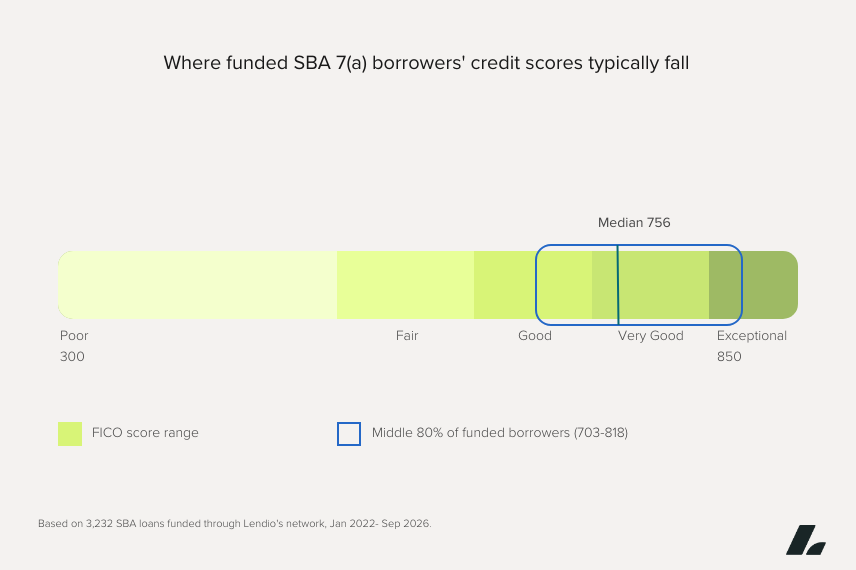
Nearly 80% of funded SBA 7(a) loans studied carried a score of 720 or higher. At the same time, almost 1 in 5 funded borrowers had a score below 720, and a small but notable share (2%) were approved with a score under 680.
What lenders look for beyond credit scores.
Credit is only one piece of an SBA loan application. Lenders often review a combination of financial and operational factors, including:
- Overall credit profile and payment history
- Current cash flow and projected income
- Existing business and personal debt
- Financial statement and tax returns
- Owner equity invested in the business
- Business plan and growth outlook
- Collateral, when required by the program
A well-prepared application that demonstrates financial stability can help lenders feel confident even when credit history is not perfect.
Credit score and revenue don’t move together the way you’d expect.
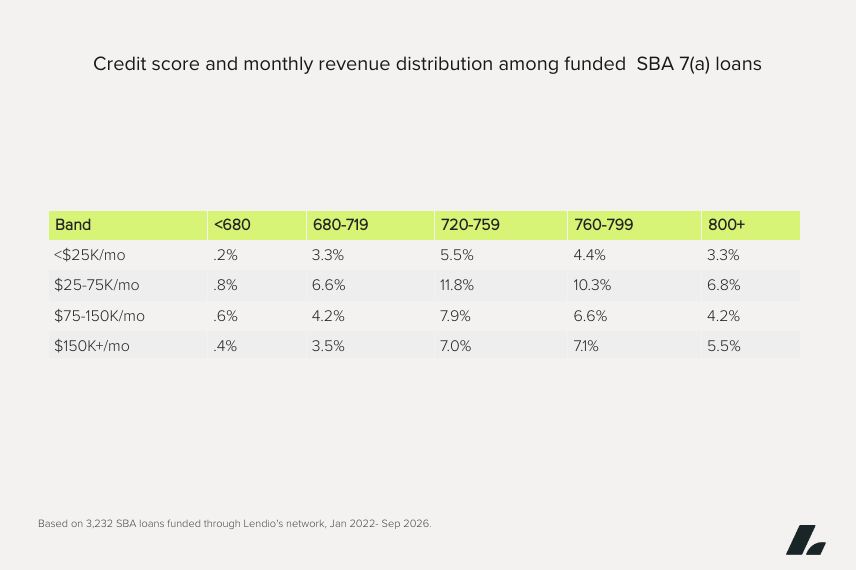
Looking at credit score and monthly revenue together across Lendio’s funded SBA 7(a) loans, the two don’t correlate as tightly as many applicants assume. The largest percent of funded loans sits in the middle of both ranges. Moderate to strong revenue paired with credit scores in the high 600s to 700s holds the largest percent of funded SBA 7(a) loans in the study, but funded loans appear in nearly every combination of the two.
Strengthening your credit profile before applying.
If you’re preparing to apply for an SBA loan, improving your credit profile may strengthen your application. Common preparation steps include:
- Reviewing personal and business credit reports for accuracy
- Addressing outstanding delinquencies or past-due accounts
- Reducing outstanding debt when possible
- Avoiding unnecessary new credit inquiries
- Maintaining consistent, on-time payments over time
These actions support a stronger overall financial picture rather than targeting a specific score.
Can you still qualify with lower or limited credit history?
Some borrowers with limited or imperfect credit histories may still qualify for SBA financing, depending on the lender and program. Lenders may consider additional strengths such as:
- Consistent business cash flow
- Valuable collateral or equity contribution
- Several years of operating history
- Strong management experience
- Clear financial documentation and projections
Lendio’s funded loan data reflects this in practice. Businesses with credit scores below 680 have been approved for SBA 7(a) financing across every monthly revenue range in the data, from under $10,000 to over $200,000 a month in average monthly sales. Score alone didn’t determine the approval outcome in these cases: the surrounding financial picture did.
Because underwriting standards vary, outcomes can differ from lender to lender.
Credit is one part of the SBA loan equation.
When it comes to SBA loans, credit score alone does not determine eligibility. For the full list of what lenders evaluate, see our guide to SBA loan eligibility requirements. Lenders assess credit as part of a broader review of financial health, business stability, and repayment capacity.
Understanding how lenders evaluate credit (and preparing your full financial profile accordingly) can help you approach the SBA loan process with clearer expectations and stronger readiness.
Sources
- U.S. Small Business Administration (SBA). SBA Standard Operating Procedure (SOP) 50 10 — Lender and Development Company Loan Programs. Version 8. Effective June 2025.
- U.S. Small Business Administration (SBA). SBA Procedural Notice 5000-875701—Sunset of SBSS Score for 7(a) Small Loans. Effective March 1, 2026.
- Lendio. Internal analysis of 3,232 SBA 7(a) loans funded through the Lendio network. January 2022- September 2026.

Prequalifying for a business loan gives you a low-risk way to understand your financing options before committing to a full application. Because it typically involves a soft credit inquiry rather than a hard pull, prequalification allows you to explore potential funding matches without affecting your credit score.
This guide explains how business loan prequalification works, what lenders typically review, and how it differs from preapproval. Individual requirements vary by lender and loan type.
What is business loan prequalification?
Business loan prequalification is a preliminary assessment that helps lenders determine whether your business may be a potential fit for their loan products.
After you provide basic financial information, the lender reviews it to estimate:
- Whether your business appears to meet general eligibility criteria
- A potential loan amount range
- Approximate terms or repayment structure
Prequalification is considered a low-commitment first step. It typically does not require a hard credit check or extensive documentation. Instead, it gives both you and the lender an early indication of fit before moving into full underwriting.
Prequalification is not a loan offer, and final terms may change after formal review.
Why prequalification matters.
Applying for a small business loan without understanding where you stand can cost time and, in some cases, affect your credit profile if multiple hard inquiries occur.
Prequalification helps you:
- Set realistic expectations about borrowing capacity
- Identify lenders more likely to work with your business profile
- Avoid applying for loans that may not align with your current qualifications
- Compare options before committing to a formal application
For many business owners, it serves as a preparation step rather than a final decision point.
What lenders typically review during prequalification.
During prequalification, lenders evaluate high-level indicators of financial health and repayment capacity. While specific criteria vary, lenders commonly review:
Credit profile
Your credit profile shows how you’ve managed debt in the past. Many lenders use a soft inquiry at this stage to evaluate general credit patterns without affecting your score.
Revenue and cash flow
Lenders look at estimated monthly or annual revenue to determine whether your business generates sufficient income to support loan payments across operating expenses.
Time in business
The length of time your business has been operating is often considered. Some lenders have minimum time-in-business requirements, so prequalification can help identify which lenders may be open to earlier-stage businesses.
Collateral and personal guarantees.
If the loan product requires collateral or a personal guarantee, lenders may assess whether sufficient assets are available to secure the loan.
Because prequalification relies on preliminary information, it provides estimates rather than final determinations.
What prequalification does not do.
Prequalification is a useful starting point, but it is not a formal approval or commitment.
At this stage, lenders have not:
- Conducted a full document review
- Verified tax returns or financial statements
- Finalized interest rates or fees
- Issued binding loan terms
Once you submit a full application, loan terms, rates, and approved amounts may change based on verified financial data and underwriting review.
Business loan prequalification vs. preapproval.
Business owners often confuse prequalification with preapproval. While related, they serve different purposes.
| Prequalification | Preapproval |
|---|---|
| Preliminary assessment | Anticipated approval from lender |
| Typically involves soft credit inquiry | Typically involves hard credit inquiry |
| Minimal documentation | Detailed financial documentation required |
| Provides estimated terms | Provides more specific loan terms |
| Helps you explore options | Signals readiness to move forward |
Prequalification is often helpful when you are exploring financing options. Preapproval is more appropriate when you are ready to move forward with a specific lender and want a clearer picture of finalized terms.
Documents and information commonly requested for prequalification.
Prequalification requires limited paperwork, but lenders typically ask for:
- Basic business information: Name, address, industry, legal structure (LLC, corporation, sole proprietorship, etc.)
- Estimated monthly or annual revenue: A general snapshot of income
- Time in business: How long your company has been operating
- Ownership structure: Business owners and roles
- Use of funds: How you plan to use the loan
While estimates are acceptable during this stage, accuracy remains important. Overstating revenue or understating existing debt can lead to complications later in underwriting.
Being transparent early helps ensure smoother transitions into a full application if you decide to proceed.
What happens after prequalification?
If you choose to move forward, the lender may request documentation such as:
- Business bank statements
- Tax returns
- Profit and loss statements
- Identification and ownership verification
This begins the formal underwriting process. Final loan terms, including rates and fees, are determined during this stage.
How prequalification supports better financing decisions.
Knowing how much you may be able to borrow and what repayment could look like helps you evaluate whether financing aligns with your business goals.
Prequalification can also help you explore different loan types before committing to one structure. When you decide to apply, you do so with greater clarity about which lenders may be a better fit for your profile.
Explore your financing options in two ways.
If you’re evaluating whether financing makes sense, you have two ways to explore next steps.
1) Start with an estimate.
Interested in seeing what you may qualify for? Lendio offers a proprietary AI-powered prequalification calculator that analyzes the information you provide against historical lending data within its marketplace. Based on those inputs, the calculator identifies an estimated funding amount as well as products that may align with your business profile. This step is exploratory and helps you understand potential borrowing ranges before interacting with lenders.
2) Submit a single application to view potential offers.
Lendio’s AI-powered decisioning software evaluates the business information you provided and mirrors what a real lender is likely to offer. If you move forward, participating lenders may present formal offers after reviewing your application.
Both options allow you to explore financing before committing to a final decision. Approval, rates, and terms are determined by the lender during underwriting.
Filling out an application for business funding and submitting it to our funding partners will not impact your personal credit score. However, depending on the product and lender, accepting a funding offer may result in a hard credit inquiry, which could affect your personal credit score.

Getting a business loan can be the difference maker when starting a new venture or even expanding upon an existing offering, and there’s significant funding available to qualify businesses. In fact, the Small Business Administration (SBA) approved over $31 billion through its 7(a) loan program in 2024 alone.
But this money doesn’t come without some work on your part, and most reputable business loans require documentation of your creditworthiness and ability to repay. Whether you’re trying for an SBA loan or another funding option, you’ll need to provide the proper paperwork to back up your case.
Why preparation matters in the loan process
Having your documents complete and organized can significantly speed up the approval process. Without them, you could experience an unnecessary delay or even decline (even if you’re otherwise well-qualified). For each piece of missing or unclear documentation, the lender needs to reach out at least once, and too many back-and-forths could leave your loan in limbo.
Worse yet, a messy or incomplete set of loan documentation may give the lender the wrong impression. It’s more likely that you’ll hand over incorrect calculations or outdated tax papers instead of what’s needed to prove your profitability and get the “yes” you really need.
There’s no one-size-fits-all application packet you can use to apply for multiple loans, but many of the required documents will be the same from lender to lender. Whether this is your first loan attempt or your third, this loan application checklist can help you save time and frustration in your funding journey.
The ultimate small business loan checklist
Even if you’re not looking to borrow money just yet, having these essential documents handy can reduce preparation work when the time comes.
Business information
- Legal business name: The official, registered name of your company and any “doing business as” (DBA) names, if applicable. You can find this on your state or local business registration documents.
- Business address and contact info: The physical location and primary contact details for your company, as listed on company records, utility bills, or vendor statements.
- Business structure: Listed as Limited Liability Corporation (LLC), S-Corp, C-Corp, partnership, or sole proprietor in your incorporation documents or state registration filings.
- Employer Identification Number (EIN): This IRS-assigned tax ID number can be found in your confirmation letter or online IRS account.
- Business license and registrations: These are usually given by your local, state, or federal licensing authority, depending on your business type.
Loan request details
Consider how much and what kind of loan you’ll need before you apply. You’ll need to provide:
- Loan amount requested: The specific dollar amount you wish to borrow, including any fees.
- Intended use of funds: A brief explanation of how you’ll spend the money, including hiring, new equipment, or working capital.
- Desired loan type: The type of funding you’re seeking (example: an SBA 7(a) loan, or other, like a line of credit, or short-term funding.
If you know your desired repayment terms, you can list them as well. (Refer to the lender’s term sheet, if available.)
Personal information
In addition to the company’s information, you’ll need to provide information for the owner or sole proprietor. This often includes:
- Government-issued ID, such as a driver’s license or passport.
- Social Security Number, to help in the credit check process.
- Personal address and contact phone number.
- Ownership percentage, which can be found in the operating agreement or company bylaws.
- Personal finance statement, or a summary of your personal assets, liabilities, income, and expenses, is found within your personal finance software or bookkeeping tools.
Business financial statements
These essential financial statements show the bank how you’re doing and your prospects for the future. You can usually find them in your accounting software or request them from your accountant.
- Profit & Loss Statement: Covering the last 1-2 years, this should show revenue, expenses, and net income over a period.
- Balance sheet: This rundown of assets, liabilities, and equity is a snapshot of a certain date and
- Cash Flow Statement: It reports the money flowing in and out of your business during a set time.
- Year-to-date financials: The most current financial data for the ongoing year, plan to run this right before you apply.
Tax returns
Include both a set of your business and personal tax returns, which you can get from your accountant or tax preparer.
- For business: Show the last 2 years, including any forms that show income, expenses, and liabilities.
- For personal: Show at least a year for each of the major owners or partners.
Don't have tax returns for your business available? Read our guide to no-doc business loans for business loan options without tax returns!
Bank statements
Provide three to six months of bank statements for all accounts tied to your business. Small proprietors or very small businesses should have personal bank statements available, as well.
Business plan
Startups and those applying for SBA loans should be prepared with a business plan, which contains, at a minimum, the following sections:
- Executive summary: This short overview states your business purpose, goals, and the plan for the loan request.
- Business model and revenue strategy: Describe how your business makes money and uniquely serves customers.
- Competitive analysis: This gives an overview of competitors with similar offerings and how you’ll compete against them in the marketplace.
- Financial projections: A forecast of future revenue, costs, and profits, it’s usually created for the next three to five years and can be prepared with your accountant.
- Use of funds breakdown: This detailed list shows how the loan money will be spent, dollar by dollar.
Debt schedule
Most businesses owe at least some money on credit cards or with previous loans. These documents demonstrate this, so lenders know what type of risk they will be taking. Include all current business debts, including current loans and credit lines, the lender names, balances, monthly or quarterly payment amounts, and due dates.
Additional documents (depending on loan type)
Different loans have varying requirements. Consider having this paperwork available just in case:
- Accounts receivable aging reports: These detail unpaid customer invoices by date and can be found within your accounting software.
- Commercial lease agreement: If you rent space, you’ll need to provide a signed lease from your landlord to establish your business’s right to operate at your location.
- Equipment invoices or quotes: Requests for equipment financing require these, which you can get from your equipment seller or dealer.
- Articles of incorporation or partnership agreements: These legal documents establish your company or partnership and show the ownership structure. Request them from your state filing authority or your business legal professional.
Special considerations for SBA Loan requirements
SBA loan amounts can be higher, so the application process is often more document-intensive. Be prepared to show a higher level of detail with thorough financial disclosures than what you may need for smaller loans through private lenders.
There’s no standard SBA checklist, since lenders administer the loans in their own way, but expect to provide standard information on certain SBA-specific forms, such as Form 1919 (Borrower Information Only) and Form 413 (Personal Financial Statement).
Personal and business credit scores can carry more weight than with other lending programs, so take the time to check your score before you apply and resolve any outstanding issues that could hold you back from an approval. Also, SBA loan requirements often include a business plan. You can read up on how to create one in our step-by-step business plan guide.
Tips to streamline the application process
Since you’ll be asked to provide your most updated copies of each document, it may be helpful to digitize (scan or download from each website) before applying. This way, you don’t have to rummage through paper stacks and can quickly send documents to the lender via their secure online processes. Also:
- Store your documents in a secure cloud folder with two-factor authentication (2FA) so only you can access it.
- Update your documents and financial calculations each month to keep them accurate and available.
- Work with your accountant or CPA to validate numbers before sending to a lender.
- Check your credit reports well in advance of applying, so you have time to dispute or fix any errors.
Set yourself up for success
A business loan opens the door for expansion and new opportunities, and – in some cases – it may be just what you need to stay afloat in uncertain times. No matter what you intend to use the money for, loan approval depends on not just what you ask for, but how well-prepared you are to ask for it. Referring to this checklist early and often can reduce the number of surprises that arise during the application process and can keep your loan request moving as quickly as possible through what can be weeks or even months of qualification.

A draw period is the early phase of a revolving business loan when you can borrow, repay, and re-borrow up to your approved credit limit, typically while making interest-only payments. A repayment period is the phase that follows: the line closes to new borrowing, and you pay back the outstanding balance on a fixed schedule that includes both principal and interest.
Together, these two phases make up the full life of most business lines of credit. The amount you borrow matters. The rate you pay matters. But the structure between these two phases is what really shapes your cash flow over time, and it's the part most borrowers miss until repayment starts and the payment jumps.
Lines of credit are now the most-sought-after financing product for small businesses. That makes the draw-vs-repayment dynamic worth understanding before you sign.
Why the difference matters.
Small business loans aren't a single event. With most revolving products (business lines of credit, working capital lines, even HELOCs that self-employed owners sometimes use) the loan behaves one way for the first few years, then changes. It goes from optional, flexible borrowing to required, structured repayment.
Why does that matter? Because cash flow doesn't just depend on what you owe. It depends on when you have to pay it back, and how that maps to your revenue. A loan that feels manageable in year one can squeeze hard in year three if you didn't plan for the transition.
How the draw period works.
The draw period is the borrowing window. During this time, you can pull funds up to your approved credit limit, pay some back, and draw again, like a credit card with a much larger ceiling. You only owe interest on what you've actually used, not on the full limit you were approved for.
(Specific line of credit interest rates depend on your lender, your business profile, and whether the line is secured or unsecured.)
Two things tend to be true during the draw period:
- Payments stay low. Most lenders only require an interest-only payment on the drawn balance, though some allow principal payments too.
- Access feels easy. No new application is needed for each draw. You can pull funds when you need them, up to the credit limit.
That combination of low minimums and on-demand access is why borrowers often describe the draw period as feeling like a stronger cash flow. It is, in a sense. But the bill for what you've drawn is still coming. It's just deferred.
How long does a draw period last? For business lines of credit, anywhere from one to five years is common, though some lenders structure shorter or longer windows depending on the product and the borrower.
How the repayment period works.
At the end of the draw period, the loan changes shape. No more new borrowing. The outstanding balance now has to be repaid (principal plus interest) on a fixed amortization schedule. (Amortization just means each monthly payment chips away at both the principal balance and the interest, until the loan is paid off.)
This is where the structure starts to matter. Because you're now paying down principal too, the monthly payment rises significantly. For many borrowers, it more than doubles. And the payment doesn't flex around your revenue here. It's what your lender's schedule says it is.
Repayment periods typically run one to five years on a business line of credit, depending on the lender and the size of the outstanding balance. Variable-rate lines may see the rate continue to adjust during repayment too, which can push the monthly payment higher or lower over time.
Draw period vs. repayment period at a glance.
Both phases are part of the same loan, but they behave very differently. Here's how they compare side by side:
Where these phases show up in business financing.
The draw-and-repayment structure isn't unique to one product. You'll see versions of it in:
- Business lines of credit. The most common context, and the focus of this article.
- Working capital lines. Short-term revolving credit, often with shorter draw windows.
- SBA CAPLines. The SBA's revolving working-capital program, which uses a similar two-phase structure. (For a related option, see Lendio's overview of the SBA line of credit.)
- Construction loans. Drawn down in stages during the build, then converted to a term loan for repayment.
- HELOCs. Primarily a homeowner product, but used by some self-employed borrowers as a business funding source.
The mechanics shift product to product, but the underlying logic is the same: a flexible window for accessing capital, followed by a structured window for paying it back.
How borrowers typically manage the transition.
Borrowers who handle the shift well tend to do most of the work during the draw period, not at the end of it. Common practices include:
- Borrowing based on projected repayment, not maximum credit. The credit limit is what you can borrow. What you should borrow is a smaller number tied to what your revenue can comfortably service later. Lenders use the debt-service coverage ratio to evaluate this, and it's a useful number to run on yourself before drawing more.
- Underutilizing the approved line. Every dollar you don't draw is a dollar you don't have to pay back. Approval ceilings are not borrowing targets.
- Repaying principal during the draw period when possible. Most lines allow principal payments early. Doing so reduces the sticker shock when the repayment period begins.
- Building a reserve to offset later payments. Setting aside part of revenue during the draw period creates a buffer for the higher payments to come.
- Tracking the true cost — APR, not just the headline rate. APR (annual percentage rate) bundles interest and most fees into one number, so it reflects what the loan actually costs you across a year. A low monthly interest payment can mask a high APR.
None of these are tactics for a specific situation. They're patterns that show up across borrowers who navigate the transition without disruption.
Common misinterpretations
A few things this concept is not:
- Low draw-period payments are not the true cost of the loan. Interest-only payments tell you only what the loan costs to carry, not what it will cost to retire. Layered line of credit fees can also push the all-in cost higher than the rate alone suggests.
- Flexible borrowing does not equal stronger cash flow. Borrowed funds are still funds you owe back. Treating draws as revenue creates a gap that shows up in repayment.
- The end of a draw period is not a default risk. It's a planned phase change, written into the loan agreement from day one. The risk isn't that the period ends; it's that the borrower didn't plan for it. (If you'd prefer to avoid two-phase structure entirely, a term loan vs. line of credit comparison is a useful next read.)
An example: a seasonal business through both phases
Consider a seasonal ice cream shop. It draws steadily from its business line of credit during the slow winter months to cover rent, payroll, and early-season inventory orders. The monthly interest-only payment stays low because the drawn balance is modest and revenue is low to match.
The draw period ends just as the busy season ramps up. Sales pick up, and so do operating costs: bigger inventory runs, extra summer staff, higher utility bills. On top of that, the line is now in repayment, and the monthly payment has more than doubled because it's covering principal as well as interest.
If the summer revenue more than covers the higher operating costs and the new loan payment, the business is fine. If it covers operating costs but not the loan payment, the gap shows up immediately. This is what people mean when they describe payment shock at the end of a draw period. It's not that the loan changed, it's that the cash flow assumption did.
This isn't a rare scenario, either. Research from the JPMorgan Chase Institute has documented just how volatile small business cash flow can be, even for otherwise healthy firms. Loan structures that assume smooth, growing revenue tend to be the ones that bite at the transition point.
Summary and key takeaways.
The draw period and the repayment period aren't two separate things, they're two halves of one loan. How they interact with your cash flow matters more than the headline numbers.
- A draw period lets you borrow, repay, and re-borrow up to a limit, usually with interest-only minimum payments.
- A repayment period closes new borrowing and requires principal-plus-interest payments on the outstanding balance.
- The transition between the two is where payment shock happens, and where most cash flow strain originates.
- Borrowers who plan during the draw period for the repayment period almost always have an easier time at the transition.
- The size of your line isn't the same as how much you should draw against it.
Cash flow disruptions are one of the most common reasons small businesses run into trouble. Understanding how the draw and repayment phases of your loan interact with your revenue is one of the more controllable pieces of that puzzle. Once you can see the structure, you can plan around it.

Choosing a business bank account used to mean walking into the nearest branch. That's changed significantly. Today's small business owners have more banking options than ever, and more to compare. Online-only banks, traditional banks with digital portals, neobanks designed for small business owners or high-growth startups. The range is real, and so is the decision fatigue that comes with it.
The right choice depends on how your business actually operates: how you handle cash, which digital tools you rely on, how much you'll pay in fees, and how much personal service matters to you. This guide breaks down the key differences, clarifies what to look for, and gives you a straightforward path to opening the right account.
What is online banking?
Online banking for small business is the use of digital platforms, including web dashboards and mobile apps, to open, manage, and operate a dedicated business bank account without visiting a physical branch. Most online business bank accounts include business checking, ACH transfers, bill pay, mobile check deposit, and financial management tools accessible 24/7.
Why a dedicated business bank account matters.
Mixing business and personal finances is one of the most common (and most avoidable) financial complications small business owners face. A dedicated business bank account keeps the separation clean, and the benefits reach further than most people expect.
From a legal standpoint, a separate business account helps establish that your business operates as its own entity. For LLCs, partnerships, and corporations, this supports limited liability protections. If personal and business funds are commingled, courts can sometimes "pierce the corporate veil", which means creditors could potentially pursue your personal assets.
From a tax standpoint, a business checking account makes tracking deductible expenses significantly easier. Your accountant works from a single, clean record instead of sorting through months of mixed personal transactions.
There's also the credit dimension. A business bank account can help establish a financial track record that lenders may review when evaluating your business. Building that record early, even before revenue comes in, gives your business a verifiable financial track record from day one.
The case for online business banking.
Digital banking has become the standard, not the exception. According to the American Bankers Association, 77% of consumers now prefer to manage bank accounts through a mobile app or computer. That shift is reflected in business banking too, and for good reason.
For small business owners, the practical advantages are tangible. Online business bank accounts give you 24/7 access to account activity, eliminate branch visits for routine tasks, and make real-time cash flow monitoring possible from anywhere. When a payment clears, you know immediately. When an expense hits, it can sync directly to your accounting software (if your integrations are set up.)
That said, convenience isn't the only consideration. Some businesses genuinely need what traditional banking provides: branch-based cash handling, in-person loan officer relationships, or bundled services under one roof. The question isn't whether to bank online, it's which type of online banking structure fits how your business actually operates.
Online-only banks vs. traditional banks: What’s the difference?
Online business banking is available through two fundamentally different types of providers. Understanding the distinction upfront saves time when you start comparing accounts.
Neither type is universally better. The right choice depends on your operating model, not on which name is more recognizable.
Key features to look for in an online business bank account.
Not all online business bank accounts are built the same. Before opening an account, compare these five feature categories.
FDIC insurance and account security
Every business bank account you open should be FDIC-insured. The Federal Deposit Insurance Corporation (FDIC) protects deposits up to $250,000 per depositor, per bank, per ownership category if a member bank fails. “For early-stage businesses operating well below that threshold, standard coverage is typically sufficient,” says Yossi Eldad, Product Manager at Lili.
“But as your working capital grows, uninsured funds become a real risk worth planning around. Some online banking platforms (like Lili) address this by offering expanded FDIC coverage, up to $3 million by automatically distributing funds across a network of partner banks. This means businesses can access expanded FDIC coverage for larger balances without the burden of opening and managing multiple accounts yourself. If you regularly carry significant cash reserves, it’s worth looking for a banking partner that offers this structure.”
Credit unions carry equivalent NCUA (National Credit Union Administration) protection up to $250,000 per share owner, per account category.
You can verify any institution's FDIC membership at fdic.gov before depositing.
Expert Insight: Fees (and how to minimize them)
“Fee structures vary significantly between banks and between account tiers. Banking platforms often offer leaner, more transparent pricing than traditional banks. When evaluating your options, look for a platform that eliminates as many unnecessary fees as possible. Common fees include:
Monthly service fee:This recurring charge can range from $0 for basic accounts to $20–$40 for mid-tier accounts, and over $100 for premium tiers. Many banks allow the fee to be waived if you meet minimum balance or spending requirements, but if you don't, it's automatic.
Transaction fees:Many banks include a set number of free transactions per month and charge per transaction beyond that threshold. For high-volume businesses, these can accumulate quickly.
Wire fees:Domestic wires typically run $0–$40 per transfer and settle within one to two business days. International wires carry higher fees and can take one to five business days. Both incoming and outgoing transactions may be subject to separate charges.
Overdraft fees:When a bank covers a transaction despite insufficient funds, they typically charge $10–$35 per occurrence, on top of repaying the shortfall. Not all banks charge these, so it's worth verifying upfront.
FX fees on card purchases:Often missed by businesses that pay international vendors by debit card. Some banks charge a foreign exchange fee on every cross-border purchase, which can add up if you have regular international spend.
If your business runs primarily on ACH transfers, card payments, and mobile deposits, a no-fee online bank likely costs less in total. If you regularly deposit cash, process paper checks, or send frequent wires, account for those specific costs before choosing. ”
 Yossi Eldad, Product Manager, Lili
Mobile app and digital tools
For most small business owners, the banking app is the primary interface. Prioritize apps that let you deposit checks via mobile camera, send ACH transfers and wire payments, receive real-time transaction alerts, access statements instantly, and set up multiple sub-accounts for budgeting purposes.
Some platforms offer up to 20 sub-accounts, which makes it easier to set aside funds for taxes, payroll, or quarterly expenses without opening separate bank accounts. Several platforms also provide virtual debit cards immediately upon account opening.
Cash deposit access
Cash deposits are the clearest operational limitation of online-only banks. Without physical locations, depositing cash usually means visiting a partner retail location (often a grocery or pharmacy chain) and paying a per-deposit fee.
If your business handles significant cash regularly, a traditional bank with branch or ATM deposit access is typically the more practical fit. If cash is rare and most revenue flows digitally, this limitation matters far less.
Accounting software integrations
Time spent manually entering transactions is time not spent running your business. Most modern online business bank accounts connect directly to accounting platforms like QuickBooks, Wave, and FreshBooks, as well as payment tools like Stripe, Square, Shopify, and PayPal.
Confirm the specific integrations available before opening an account. A direct connection to your existing tools can save hours of bookkeeping each month and reduce errors at tax time.
Expert insight: The difference between accounting software integration versus built-in accounting tools.
“Both approaches can work, but they offer meaningfully different experiences and it depends on the needs of the business. A platform that integrates with accounting software , syncing transactions to QuickBooks or Xero, for example, lets you view your banking activity inside your accounting tool. It's a useful connection, but it still involves two separate systems, and syncing, categorization review, and reconciliation still require manual attention.
A platform with accounting built in keeps everything in one place. Transactions are automatically categorized as they happen, records stay current and financial reports can be generated on demand. There's no syncing lag, no duplicate data entry, and no risk of the two systems falling out of step. For business owners who aren't accountants, this kind of automation can significantly reduce the time and cognitive load of staying on top of their books. ”
Yossi Eldad, Product Manager, Lili
Understanding business banking fees.
Fees are the most common source of friction in business banking relationships, and can be easy to underestimate. A $15/month maintenance fee doesn't sound significant until you also factor in transaction fees, wire charges, and cash deposit fees on a higher-volume business. Those costs add up quickly.
Here's a breakdown of the primary fee categories to evaluate:
As a point of comparison, platforms like Lili have eliminated most of these fee categories entirely on their base account, including monthly maintenance, ACH, overdraft, and FX fees.
Actual fees vary by institution and account tier. Always review the full fee schedule for any account you're seriously considering, particularly for the transaction types your business uses most.
Matching your business to the right account.
Use this logic to narrow your options based on how your business actually operates:
- If your business is primarily digital and rarely handles cash, then an online-only bank account with no monthly fees and strong digital integrations is worth exploring first. Lili’s Core account is a strong starting point here: no monthly fees, no minimum balance, and account access almost instantly.
- If your business regularly deposits cash or processes large volumes of paper checks, then a traditional bank with branch access or business ATM deposit services is typically the more practical choice.
- If your business holds significant balances and you want to earn interest on operating funds, then look for high-yield checking options — some online banks offer up to 3.0% APY on balances when monthly spending thresholds are met. Lili’s savings account earns up to 4.00% APY with no lockups or minimum balance requirements.
- If your business needs to send or receive international payments, then evaluate wire capabilities and foreign exchange fees before opening — these vary significantly between providers.
- If you're a sole proprietor just starting out, then many online-only banks allow you to open an account with minimal documentation, often using just your Social Security number and basic business information.
- If you're an LLC or corporation, then you'll need your EIN and formation documents at minimum. Some banks require additional documentation. See the section below.
- If your business has complex banking needs, like payroll services, merchant processing, or access to business lending, then a full-service traditional bank may offer more under one roof, though many fintech platforms are rapidly expanding into these areas.
Types of online business bank accounts.
Online banking for small businesses isn't limited to checking accounts. Here are the main account types available through digital banking platforms.
Business checking accounts
The most common type of business bank account, used for day-to-day operations: receiving payments, paying vendors, covering payroll, and managing expenses. Business checking accounts are transactional by nature — built for frequent deposits and withdrawals. When people refer to a "business bank account," they typically mean a business checking account.
Business savings accounts
Business savings accounts are designed to hold funds you don't need immediate access to. They earn interest but typically limit monthly transactions. A business savings account works well for setting aside a tax reserve, emergency fund, or short-term operating reserves that you want clearly separate from your everyday checking.
High-yield business checking accounts
A growing number of online-only banks now offer high-yield business checking — combining the transactional flexibility of checking with interest rates closer to savings products. These accounts are particularly useful for businesses that maintain higher operating balances and want idle funds working for them without locking money in a savings account.
Lili offers a high-yield savings account alongside its business checking— currently up to 4.00% APY on balances, with daily earnings and no lockup periods.
Business Money Market accounts
Business money market accounts (MMAs) typically offer higher interest rates than standard savings accounts, with limited check-writing privileges. They're a middle ground between savings and checking — useful for businesses building cash reserves they may occasionally need to access quickly, without the transaction limitations of a pure savings account.
How to open an online business bank account.
Opening a business bank account online takes anywhere from 10 minutes to a few business days, depending on the institution and how prepared you are with documentation. Here's what to expect.
Documents you’ll need (by business type)
Requirements vary by business structure. Have these ready before you start your application:
Sole Proprietor:
- Government-issued ID (driver's license or passport)
- Social Security Number or EIN
- Business name, if operating under a DBA
- DBA certificate from your county or state, if applicable
LLC:
- Government-issued ID for all owners with 25%+ ownership stake
- Employer Identification Number (EIN)
- Articles of Organization or Certificate of Formation
- Operating Agreement (not always required, but frequently requested)
- Business name and address
Corporation (C-Corp or S-Corp):
- Government-issued ID for officers and major shareholders
- EIN
- Articles of Incorporation
- Corporate bylaws
- Board resolution authorizing the account (required by some banks)
Partnership:
- Government-issued ID for managing partners
- EIN
- Partnership agreement
- Certificate of Good Standing (required by some states)
Having these documents ready before you start saves time and reduces the risk of delays mid-application.
Opening your account (step-by-step)
- Choose your bank or platform. Use the comparison table and if/then scenarios above to narrow your options based on fees, cash handling needs, and integrations.
- Gather your documentation. Collect the documents specific to your entity type. Most online applications accept document uploads directly from your phone or computer.
- Complete the online application. Most online-only banks complete the process in under 20 minutes. You'll provide business information, owner details, and upload documentation during this step.
- Fund your account. Many accounts require an opening deposit between $0 and $100. Link an existing bank account via ACH, or use a debit card, to fund your new account.
- Set up your integrations. Once open, connect your accounting software, payment processors, and payroll tools. This step pays dividends every month, so don't skip it.
- Order your business debit card. Most accounts issue a physical debit card within 5–10 business days and a virtual card almost immediately for online purchases.
- Update your payment information. Notify clients, vendors, and subscription services of your new account details. Update direct deposit settings for any incoming payments.
Expert Insight: Switching to an online bank from a traditional bank.
“Switching to an online business bank is generally a much faster and simpler experience than most owners expect. While traditional banks typically require an in-person visit and can take days or even weeks to open an account, online banking platforms are fully digital. If you have the right documents ready, the whole process can take just a few minutes.
Everything is submitted through an online application. Once approved, you can access your account immediately, including a debit card for business spending, so there’s no delay in actually running your business. From there, fund it from your existing bank and update your routing and account numbers with customers, payment processors, and your payroll provider.The lowest-risk approach is to run both accounts in parallel for one full billing cycle. Once your recurring debits and direct deposits have flipped over, you can confidently close the old account. ”
Yossi Eldad, Product Manager, Lili
Building your banking stack: Integrations that save time.
One of the most underrated advantages of online business banking is the integration ecosystem that comes with it. When your bank account connects directly to your accounting software, payment processors, and payroll platform, financial management becomes significantly more efficient.
A few integrations worth prioritizing when you evaluate accounts:
- Accounting software — QuickBooks, Wave, FreshBooks, or Xero. A direct bank feed keeps your books current and eliminates manual transaction entry.
- Payment processors — Stripe, Square, PayPal, or Shopify Payments. Automatic reconciliation between your payment platform and bank account prevents end-of-month discrepancies.
- Payroll platforms — Gusto, ADP, or Paychex. A direct connection reduces manual steps in running payroll and ensures accurate fund transfers.
- Expense management — Ramp, Expensify, or Brex. Some platforms integrate directly with business checking for real-time spend visibility across your team.
- Tax estimation tools — Several online banking platforms now offer automated transaction categorization and quarterly tax estimates. Some, like Lili, take this further with pre-filled tax forms (including Schedule C, Form 1065, and Form 1120) built directly into the account dashboard.
Not every bank supports every integration. Before committing to an account, map out the tools you currently use (or plan to use) and confirm that direct connections are available. API-based integrations are generally more reliable than CSV import workarounds.
Some platforms go further than third-party syncs. Lili, for instance, includes built-in expense categorization, profit and loss statements, cash flow reporting, and pre-filled tax forms. These are native to the account, rather than connected from an outside tool. For business owners who want fewer moving parts, that distinction is worth noting when comparing options.
Expert insight: Banking setups that can save small business owners at tax time.
“The biggest time-saver is keeping your accounting tightly integrated with your banking throughout the year, not just catching up in April. When transactions are automatically categorized as they occur, your records are already organized when it's time to file.
A few specific setups that pay off at tax time:
A dedicated tax savings bucket: Some platforms let you automatically set aside a percentage of income for taxes as it comes in, so you're never caught short when quarterly payments or your annual bill is due.
Auto-categorization: Platforms with built-in bookkeeping categorize income and expenses in real time, so there's no year-end scramble to sort through months of transactions.
On-demand financial reports: Being able to generate a clean Profit & Loss statement instantly, rather than exporting data and formatting it manually, can save hours and reduce errors.
Receipt capture: Attaching receipts to transactions as they happen keeps documentation organized and audit-ready without any work at year-end.
The goal is to make tax season a summary of work already done, not a project in itself. ”
Yossi Eldad, Product Manager, Lili
What your business bank account doesn’t determine.
Choosing an online business bank account determines where you hold and manage operating funds. It does not determine:
- Whether you qualify for a business loan or line of credit. That depends on your creditworthiness, revenue, time in business, and lender-specific criteria.
- Which payment processor is right for your business.
- Whether you need a business credit card. This is a separate product with its own application and approval criteria.
- Your bookkeeping or accounting structure.
If you're also evaluating business financing options, Lendio connects small business owners with a marketplace of lenders across loan types and structures. Your banking relationship and your financing options are separate decisions, but a strong banking history tends to work in your favor when it comes time to apply.
Summary and Key Takeaways
Choosing an online business bank account comes down to matching account features to how your business actually operates, not defaulting to the biggest name or the most heavily advertised no-fee offer.
The choice between online-only banks and traditional banks with digital access largely depends on cash handling needs, fee structure, interest potential, and service preferences. Both can work well. What matters is fit.
- Open a dedicated business bank account early, before revenue comes in if possible. The financial separation it creates has legal, tax, and credit implications that compound over time.
- Verify FDIC or NCUA insurance on any account you consider. For businesses holding larger balances, look for sweep network options that extend coverage beyond the standard $250,000.
- Compare fee structures based on how you'll actually use the account (not just the monthly maintenance fee.) Transaction fees, wire fees, and cash deposit fees can add up quickly depending on your volume.
- Prioritize accounting integrations from day one. A direct connection between your bank account and bookkeeping software reduces manual entry and makes tax season significantly easier.
- Your bank account is a financial foundation, not a financing solution. If you're also evaluating business loans or lines of credit, that's a separate decision, and one where having a clean banking history works in your favor.

What is business credit?
Business credit is a track record of financial responsibility that belongs specifically to your company, not you personally. Think of it as your business’s own credit score. While your personal credit reflects your individual financial behavior, business credit is a separate profile built in your company’s name.
Major bureaus such as Dun & Bradstreet, Experian Business, and Equifax Small Business track this data and generate scores that lenders use to evaluate your company’s creditworthiness. These scores determine your interest rates, credit limits, and whether you qualify for financing.
It’s important to note that business credit information is widely accessible to lenders, vendors, and partners. And unlike personal credit, it won’t build itself. You have to be proactive.
Expert insight: Strong cashflow to offset a low personal credit score.
“Traditional underwriting puts a lot of weight on personal credit scores, especially for small business applicants, where the owner’s creditworthiness is treated as proxy for the business. A low score can create real barriers.
That said, the lending landscape has shifted. Many modern lenders, particularly fintechs and alternative lenders have built underwriting models that factor in real-time cash flow signals. Consistent revenue deposits, low overdraft activity, healthy average balances, and strong receivables can all work in your favor.
If your cash flow is strong, make sure it’s visible. Keep your business finances in a dedicated business bank account with a clean transaction history. Lenders who review bank statements want to see organized, consistent cash flow, not a mix of personal and business transactions. The cleaner the record, the better the case you can make even with a lower credit score. ”
Yossi Eldad, Product Manager, Lili
How the business credit-building process works.
Building business credit comes down to two things: establishing a distinct legal and financial identity for your company, and then generating a consistent record of on-time (or early) payments called “tradelines.”
Here’s the short version: form an LLC or corporation, get an EIN, open a business bank account, then use Net-30 vendor accounts and a business credit card that reports payment activity to the bureaus. After 6–12 months of disciplined payments, those tradelines crystallize into a business credit score lenders can work with.
Why establishing business credit matters in 2026.
For modern businesses, building credit is no longer just about getting a traditional bank loan. The financing landscape has shifted. According to recent industry data, 29% of small businesses now seek financing from online fintech lenders, a sharp increase from previous years. These lenders often rely heavily on automated underwriting that pulls your business credit data front and center.
A strong business credit profile also gives you real leverage on day-to-day operations. You could see better supplier terms, lower interest rates, and more breathing room in your cash flow. Businesses that build credit before they need are ones who can move fast when the right opportunity shows up.
How to establish business credit: 7 steps to take
Building business credit involves a deliberate sequence. Work through each step, and you could have a fundable credit profile within 6-12 months.
1. Form a legal business entity.
Unfortunately, you are limited in building true business credit as a sole proprietor.
To separate your personal and business identities, you need to register as an LLC or corporation with your state. This creates a “corporate veil”, or a legal separation between personal and business assets. Your business can now enter contracts, open accounts, and apply for credit under its own name rather than your Social Security number.
According to Yossi Eldad, Product Manager at Lili Bank, the advantage of making this switch goes beyond legal protection: “As a sole proprietorship, your business does not have a separate legal entity. That means it cannot build its own business credit profile. Business credit bureaus like Dun & Bradstreet, Experian, and Equivax create reports tied to a business entity such as an LLC or a corporation, not to an individual operating as a sole proprietor.
The practical implication is significant: many credit-building products, including secured business credit cards designed to establish tradelines, are only available to registered legal entities. If you’re serious about building business credit, registering as an LLC or corporation isn’t just beneficial, it’s the prerequisite. The costs and administrative requirements are relatively modest, and the credit-building upside is substantial.”
2. Secure your EIN and D-U-N-S Number.
Your Employer Identification Number (EIN) is your business’s social security number. Once you have it, apply for a D-U-N-S Number through Dun & Bradstreet. This nine-digit identifier is the global standard for tracking business credit, and is commonly used to generate a PAYDEX score and track your business credit profile.
If you’re enrolled in Lili’s BusinessBuild program, you can request and obtain your D-U-N-S Number directly within the Lili platform. No extra steps, no separate website.
3. Open a dedicated business bank account.
Mixing business and personal funds is a major friction point when establishing and building business credit, and can lead to a thin business credit file and a headache during tax season. Open a business checking account using your legal business name and EIN. This creates the financial paper trail lenders use to verify your revenue and assess your ability to repay. It’s also the foundation each following credit-building step depends on.
Expert insight: How modern lenders use "alternative data" to support a thin credit file.
“Alternative data refers to any financial information outside the traditional credit bureau reporting system that gives lenders a more complete picture of how a business manages money. As thin credit files have become a common challenge, especially for newer businesses, lenders have increasingly turned to these signals to fill the gaps.
Utility and rent payment history: While these payments don’t always appear on traditional business credit reports, some lenders may consider them during manual underwriting. In particular, commercial rent payment history is increasingly reviewed as part of a broader assessment of a business’s financial stability.
Ecommerce and payment processor data (Amazon, Stripe, Square): Platforms like Stripe Capital and Amazon Lending use their own internal data—sales volume, return rates, payment consistency, growth trends—to make lending decisions. Businesses with strong, growing payment processor histories may find it easier to access capital through these channels even without a traditional credit profile.
Bank account transaction data: With the owners consent, lenders can analyze live bank data to assess cash flow patterns, average daily balances, and revenue consistency. This has become increasingly common among alternative lenders.
The data already exists in your business activity, you just may not be surfacing it yet. Between your payment processor, your banking history, and your vendor relationships, there’s likely a much richer financial picture of your business than a traditional credit file shows. The opportunity is making sure the right lenders can see it. ”
Yossi Eldad, Product Manager, Lili
4. Establish Trade Lines with reporting vendors.
The most reliable way to “prime” a business credit report is through Net-30 vendor credit. Net-30 vendors are vendors who allow businesses to buy goods on credit and pay within 30 days. The most common examples are vendors like U-Line, Grainger, Quill, and Amazon Business. The benefit of these vendors is that they report payment history to credit bureaus.
Expert insight: On making sure the bills you pay are actually helping you build your score.
“This is one of the most common — and costly — mistakes we see: business owners paying vendors reliably for years, only to discover none of it has ever appeared on their business credit report.
A few strategies that actually work:
Verify before you open the account. Before establishing a vendor relationship specifically to build credit, ask directly: 'Do you report payments to Dun & Bradstreet, Experian, or Equifax Business?' If the answer is no or uncertain, that account won't help you build business credit, no matter how perfectly you pay.
Use Dun & Bradstreet's trade reference submission. D&B allows businesses to submit trade references for manual review. If you have a vendor you've been paying reliably that doesn't report automatically, you can submit that payment history to D&B for potential inclusion in your credit profile. It's not guaranteed, but it's a legitimate path that most business owners don't know exists.
Prioritize vendors known to report. When evaluating vendors for routine purchases, give preference to those that offer net payment terms and report to at least one bureau. Turning everyday spending into credit-building activity is one of the most efficient moves available to small business owners.
Use a business credit card that reports. Business credit cards, especially secured cards designed for credit building, typically report to at least one major bureau monthly. That means every on-time payment is actively working for your credit profile.
The bottom line: never assume reporting is happening. Verify it before you count on any relationship to build your score. ”
Yossi Eldad, Product Manager, Lili
5. Apply for a business credit card.
A business credit card adds a revolving line of credit to your profile. This is a different credit type than Net-30 trade lines, and strengthens your overall score.
Note: Most cards require a personal guarantee early on. That’s normal. Your goal is to leverage these accounts to build the business’s own principal credit profile over time. This way, you can eventually move toward corporate credit that doesn’t rely on you personally.
Make sure the card you choose reports specifically to business credit bureaus. Not all of them do!
Spotlight on the BusinessBuild Credit Card from Lili:
If you’re looking for a credit card purpose-built for this stage, Lili’s BusinessBuild Credit Card is worth a look. It’s a secured card, meaning you set a refundable deposit that becomes your credit limit. There’s no credit check required and no interest. Every month, your payments are automatically reported to Dun & Bradstreet, helping you build a real credit profile from day one. It’s designed specifically for business owners at this stage of the journey: accessible to get, and built to grow with you.
6. Optimize your payment habits.
In the world of business credit, “on-time” is a B-grade. Early payments are how you get an A.
Unlike personal credit, the PAYDEX score rewards businesses that pay 10-15 days before the due date with scores of 90+, whereas a payment made exactly on the due date typically results in a score of 80. That gap matters when lenders are evaluating risk.
Yossi Eldad explains the real-world implications: “Paying early can genuinely move the needle, particularly with Dun & Bradstreet. D&B’s PAYDEX score is designed to reflect payment performance relative to terms. A score of 80 means on time, and scores above 80 reflect early payment. Those higher scores are achievable and recognized.
From a lender's perspective, early payment signals cash flow health and financial discipline — the profile of a lower-risk borrower. One caveat: not all bureaus weight early payment the same way D&B does, so the impact varies. As a rule of thumb, aim to pay a few days before the due date. It buffers against processing delays and, with D&B, actively contributes to a stronger score."
7. Monitor your business credit reports.
Errors are more common on credit reports than you might think, and they can quietly derail your funding eligibility. Services like Nav or Experian Business are great options. Another approach worth considering: Lili’s BusinessBuild program includes 24-7 access to six key D&B scores: PAYDEX, Delinquency Score, Failure Score, D&B Rating, Credit Limit Recommendations, and D&B Viability Rating. All six are visible in your Lili account, and real-time alerts notify you the moment something changes.
Proactive monitoring means you catch and fix inaccuracies before they cost you a loan approval. Don’t wait until you’re in the middle of a financing application to find out something is wrong.
"Monitor your business credit reports actively and dispute errors immediately when you find them.
The vast majority of small business owners have never looked at their business credit report. But errors are common: misattributed accounts, incorrect payment statuses, data from a similarly named business. These mistakes can silently drag down your scores and cost you financing opportunities without you ever knowing it.
Beyond catching errors, active monitoring helps you understand what's actually driving your scores — which tradelines are reporting, what's working, and where there are gaps. ”
Yossi Eldad, Product Manager, Lili
Pitfalls to look out for.
Building business credit involves some patience, and a few stressful surprises if you aren’t prepared. Here’s what to watch out for:
- Documentation gaps: A single misspelling of your name on a utility bill can prevent a bureau from linking that payment to your file. Make sure you check documents for accuracy, particularly for legal business name, address, and EIN.
- Utilization: Unlike personal credit, business credit doesn’t always follow strict utilization thresholds. However, consistently carrying high balances can still impact how lenders evaluate your risk, so it’s best to keep utilization at a manageable level.
- Reporting lag: It typically takes 60-90 days for a new tradeline to appear on your credit report. Don’t panic if your first purchase doesn’t show up immediately. Patience is part of the process.
Summary.
- Entity first: You cannot build true business credit as a sole proprietor. Form an LLC or corporation before anything else.
- Early is the new on-time: Pay vendors 10–15 days early to maximize your PAYDEX score and signal financial strength.
- Use the right tools. A purpose-built program like Lili BusinessBuild consolidates your credit card, D&B reporting, score monitoring, and training in one place. Nothing slips through the cracks.
- Monitor proactively: Use your EIN and D-U-N-S to track your progress and fix errors quickly.
- Build business credit before you need it: Businesses that establish credit in advance are the ones positioned to scale when opportunity strikes.

Interest on a business line of credit accrues only on the amount you borrow — not your full credit limit — and is typically calculated using a daily balance method based on your annual percentage rate (APR).
Understanding how that interest compounds, what fees get folded into your total cost, and how variable rates can shift your payments over time is what separates a good financing decision from a costly one.
What is interest on a business line of credit?
Interest on a business line of credit is the cost you pay to borrow money from your available credit, and it only applies to what you’ve actually drawn, not your total limit.
Your lender sets a maximum credit limit — say, $50,000 — and you can borrow from it, repay it, and borrow again as needed. As you draw funds, interest begins accruing on the outstanding balance. Once you repay, that interest stops.
So if you have a $50,000 line and draw $10,000, you’re only paying interest on that $10,000. The remaining $40,000 sits available at no cost (at least where interest charges are concerned.) This is what separates a line of credit from a term loan, where interest accrues on the full lump sum from day one, regardless of how much you actually use.
Interest rate vs. APR: What’s the difference?
This is the distinction that trips up most business owners — and it matters a lot when comparing lender offers.
The interest rate (sometimes called the “nominal rate”) is the base cost to borrow, expressed as an annual percentage. It doesn’t include fees.
APR is the interest rate plus certain fees, expressed as a single annual figure. Because APR folds in costs like origination fees and annual maintenance fees, it’s almost always higher than the base interest rate.
APR is also the most reliable metric for comparing two different lender offers side by side.
Two lenders might both advertise a 9% interest rate. But if one charges a 2% origination fee and a $150 annual fee, and the other charges nothing beyond interest, the APRs will be meaningfully different — and so will your actual cost of borrowing.
Always ask for the APR, not just the interest rate, when evaluating a line of credit.
How interest is calculated on a business line of credit.
Most lenders calculate interest using the average daily balance method. Here’s how it works:
- Your lender divides your APR by 365 to get a daily periodic rate. At a 12% APR, that’s roughly 0.0329% per day.
- That daily rate is multiplied by your outstanding balance each day. If you borrowed $10,000 at a 12% APR, your daily interest charge is approximately $3.29.
- Daily charges are summed over your billing period. Over a 30-day month with a constant $10,000 balance, you’d accrue about $98–$99 in interest.
Some lenders use a 360-day year instead of 365 for this calculation, which slightly increases your effective daily rate. It’s worth confirming which method your lender uses before you sign.
Daily vs. monthly compounding
Some lines of credit compound interest monthly rather than daily, meaning interest accrues on unpaid interest from prior periods. Daily compounding is more common with online and alternative lenders; monthly compounding is more typical at traditional banks.
Daily compounding results in a slightly higher effective rate over time — which is another reason APR is the cleanest comparison tool, since it already accounts for how compounding affects your true annual cost.
Fixed vs. variable rates on a business line of credit.
Most business lines of credit carry variable interest rates, meaning your rate can move up or down over the life of the line. Variable rates are typically tied to a benchmark like the prime rate (the rate banks use as a baseline for consumer and business lending) or the Secured Overnight Financing Rate, or SOFR (a widely used benchmark that replaced LIBOR for many commercial loan products). When those benchmarks rise, your interest rate rises with them — and so do your monthly payments on any outstanding balance.
Fixed-rate lines of credit are less common but available, particularly from traditional banks. A fixed rate means your interest cost stays the same no matter what happens in the broader market, which makes budgeting more predictable.
According to the Federal Reserve Bank of Kansas City’s Small Business Lending Survey, average rates for new business lines of credit in Q3 2025 were:
• Variable-rate lines: 7.6%–7.9% (varying by urban vs. rural banks)
• Fixed-rate lines: 7.0%–7.3%
Those figures reflect well-qualified borrowers at traditional banks. Rates from online and alternative lenders can run significantly higher — sometimes 30%–60% or more — depending on your credit profile and the lender’s underwriting criteria. That’s not a reason to avoid online lenders, but it is a reason to compare APRs carefully across all your options.
Fees that increase your total borrowing cost.
Interest isn’t the only cost to factor in. Business lines of credit often come with fees that can materially change what you pay to borrow, and not all lenders are upfront about them.
- Draw fees are charged each time you pull funds from your line, typically 1%–3% of the amount drawn. On a $20,000 draw, a 2% draw fee adds $400 to your cost before interest even accrues.
- Origination fees are charged when the line is first opened, usually 1%–3% of the total credit limit.
- Annual or maintenance fees keep the line open even when you’re not actively borrowing. These typically run under $200 per year but add up over the life of the account.
- Prepayment penalties are less common on lines of credit than on term loans, but worth asking about if you plan to pay down your balance quickly.
All of these fees should be factored into your APR comparison — which is exactly why APR, not the nominal rate, is the number to focus on.
What your business interest rate depends on.
Lenders evaluate several factors when setting your rate. Understanding them helps you see where you have room to negotiate — or where preparing more thoroughly before you apply can make a real difference.
- Credit profile. Both your personal and business credit scores affect your rate. Higher scores typically unlock lower APRs, especially with traditional banks.
- Business revenue and cash flow. Steady, documented revenue signals lower risk to lenders. Businesses with strong cash flow often qualify for more competitive rates.
- Collateral. Secured lines of credit — backed by assets like inventory, receivables, or equipment — typically carry lower rates than unsecured lines, because the lender has recourse if you can’t repay.
- Lender type. Bank rates tend to be lower but come with stricter qualification requirements. Online lenders are more accessible but price their additional risk into higher rates.
- Credit limit and term. Larger credit limits and longer draw periods can mean higher rates, since they represent more exposure for the lender.
What people often get wrong about business line of credit interest.
A few misunderstandings come up consistently — and clearing them up early can save you from surprises down the road.
- “A low interest rate means a low cost.” Not necessarily. A 7% rate with a 2% draw fee, $500 origination fee, and $150 annual fee can cost more in real terms than a 10% rate with no additional fees. Always calculate APR.
- “I’m paying interest on my full credit limit.” No — interest only accrues on the amount you’ve drawn. The undrawn portion of your line carries no interest cost.
- “Variable rate means my rate will definitely go up.” Variable rates move in both directions. When benchmark rates decline, your rate can drop too — as many borrowers saw during the Fed’s rate cuts in late 2025.
- “APR and interest rate mean the same thing.” They don’t. Interest rate is the base cost to borrow; APR is the total cost including fees. Comparing interest rates without looking at APR is an apples-to-oranges comparison.
Example: Estimating interest on a $50,000 draw.
Say you draw the full $50,000 from your business line of credit at a 10% APR. Using the daily balance method:
- Daily rate: 10% ÷ 365 = 0.0274%
- Daily interest on $50,000: $50,000 × 0.000274 = $13.70/day
- Monthly interest (30 days): approximately $411
Now say you pay back $10,000 in the first week. Your outstanding balance drops to $40,000, and your daily interest charge drops to roughly $10.96/day for the rest of the month. That partial payment meaningfully lowers your total interest for the period — without requiring you to pay everything off at once.
This is why paying down your line of credit quickly, even partially, reduces your total interest cost more effectively than waiting for scheduled payment dates.
Summary & Key takeaways.
Interest on a business line of credit accrues only on what you borrow, making it a flexible and potentially cost-efficient way to access working capital. The number that matters most is APR — not just the nominal interest rate — because APR reflects fees and gives you a true comparison across lenders.
Most lines of credit use the daily balance method, and variable rates mean your cost of borrowing can shift over time. Paying down your balance quickly is one of the most effective ways to reduce total interest paid.
Lendio makes it easy to compare multiple lender offers tailored to your business — so you can see real terms side by side and move forward with confidence.
Related resources
- Business Line of Credit Interest Rates — current average rate ranges by lender type
- Business line of credit fees – a breakdown of additional fees on top of interest
- Business Line of Credit — how to apply and what to expect
- Business Loan Calculators — estimate your monthly payments
- Build Business Credit With a Line of Credit — how a line of credit affects your credit profile